Most accessible listing terms have no single legal definition in the rental market: "roll-in shower," "step-free entry," and "wheelchair accessible" are descriptions a landlord writes, not certifications. The numbers that do have force come from standards — a 32-inch clear doorway width in the Fair Housing Act design requirements and the ADA 2010 Standards, and a covered-building cutoff of first occupancy after March 13, 1991 for FHA requirements. Your job as a reader is to separate defined terms from marketing and verify everything.
Fair housing rules and building codes vary by jurisdiction and building type, and specifics should be confirmed with the property and, where needed, a local fair housing organization.
Why do listing terms vary so much?
There is no national checklist a landlord must use to describe a unit. A listing site may offer an "accessibility features" field, but the landlord fills it in, and there is rarely a verification step before it goes live. The Fair Housing Act design requirements only apply to covered multifamily buildings — generally those with four or more units and first occupancy after March 13, 1991 — so a huge share of the housing stock predates any federal accessibility requirement entirely.
That means the same phrase can describe very different homes. One landlord's "roll-in shower" is a true curbless stall with a handheld spray and a bench. Another's is a standard tub with a removable chair and the word "roll-in" added because it rents faster. The terms below tell you what to ask for each time.
What does "roll-in shower" actually mean?
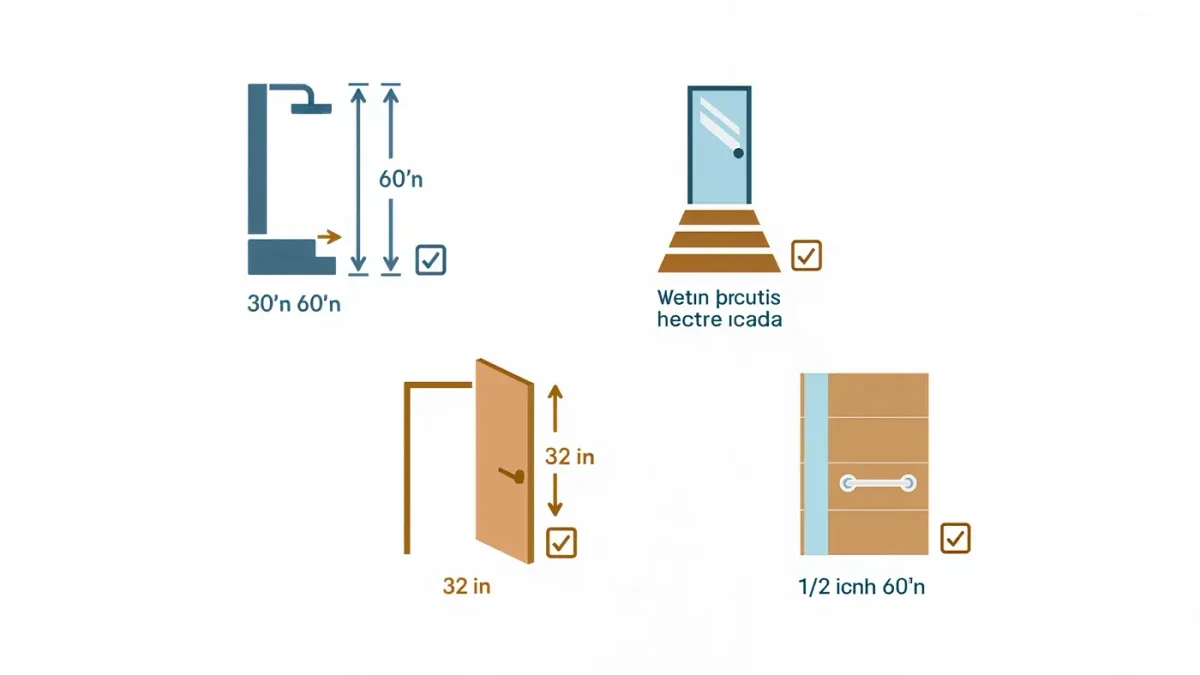
A true roll-in shower has no curb or threshold to cross — the bathroom floor and shower floor are one continuous surface, usually sloped gently toward a drain, with enough clear floor space for a wheelchair to enter and turn. The ADA 2010 Standards set the benchmark dimensions for roll-in showers in the buildings they cover: a 30-by-60-inch stall size, with a 36-by-36-inch minimum allowed in some alteration cases.
In a listing, "roll-in shower" is not certified to any standard in most private-market rentals. Ask two questions: is there any lip or threshold at the shower edge, and what is the stall size in inches? If the answer includes the words "tub" or "curb," it is not a roll-in shower no matter what the headline says. Also ask about the drain type, because a curbless shower with an undersized drain will pool water on the bathroom floor.
What does "step-free" or "zero-step" entry promise?
A step-free entry means an uninterrupted route from where you park or get dropped off to the front door, without a stair or a high threshold. The relevant benchmark is threshold height: the ADA 2010 Standards and FHA design requirements both point to a maximum of 1/2 inch at a doorway, with anything above 1/4 inch beveled.
The trap in listings is scope. A unit can be "step-free entry" with a level front door and still have a two-inch threshold at the patio, a sunken living room, or interior steps to the bathroom. Ask for the route in full: sidewalk or parking area to building entry, building entry to unit, unit entry to every room, with threshold heights. Get it in writing if the listing is your deciding factor.
What do "ADA-compliant" and "accessible unit" mean in a listing?
"ADA-compliant" is the most misused term in housing listings. The ADA 2010 Standards apply to public accommodations and government facilities — and to common areas of certain housing — but not to the interior of a private rental unit or a single-family home. When a private landlord writes "ADA-compliant apartment," the phrase has no fixed legal meaning for that unit. It usually signals some accessible features, but which ones is anyone's guess until you ask.
Terms with more bite appear in covered multifamily buildings: FHA design requirements, and ICC A117.1, the accessibility standard many building codes adopt, define unit types such as Type A and Type B units. A Type B unit roughly matches the FHA baseline — accessible route, 32-inch doors, reinforced bathroom walls, usable kitchens and baths — while a Type A unit is held to more extensive requirements where the local code demands it. If a listing or a leasing agent names a unit type, ask which standard and version, and get the answer in the lease paperwork.
Which listing terms should you treat as red flags?
Some phrases reliably mean less than they appear to. Treat each of these as a prompt for follow-up questions, not information:
- "Handicapped-friendly" or "disabled-accessible" — vague, with no standard behind them; ask for a feature list
- "Walker-friendly" — often means only that there are no stairs; says nothing about door widths or the bathroom
- "Recently updated accessible bathroom" — "updated" can mean new tile over the same narrow door and a threshold at the shower
- "Accessible parking nearby" — "nearby" is not a reserved, marked space with an access aisle; ask for the space number and aisle dimensions
- "Could be made accessible" — a true statement about almost any ground-floor unit; it is an offer of renovation negotiation, not a feature
How do you verify a listing before you tour?
Verification is mostly asking narrow, numeric questions, because numbers are harder to fudge than adjectives. Work through this list by email or message so you have the answers in writing:
- Clear width of each doorway you will use, measured with the door open 90 degrees — you want at least 32 inches
- Threshold heights at every entry, inside and out, in fractions of an inch
- Bathroom layout: stall or tub, curb height if any, wall reinforcement behind shower and toilet, grab bars present or not
- Turning space in the bathroom and kitchen — 60 inches of clear floor diameter is the standard benchmark
- Route from parking or drop-off to the unit: slopes, stairs, surfaces, and distances
- Parking: reserved accessible space, access aisle width, distance to the door
- Building build year or first-occupancy date, which tells you whether FHA design requirements could apply
A landlord who answers with real numbers is telling you something. A landlord who answers "it's very accessible, you'll love it" to every question is telling you something too.
What laws back you up if a listing misleads you?
If a covered building was required to meet FHA design requirements and does not, that is a design-and-construction issue under the Fair Housing Act, and complaints can be filed with HUD or a state or local fair housing agency — timelines apply, so act promptly if this is your situation. Separately, the Fair Housing Act requires landlords to allow reasonable modifications and reasonable accommodations regardless of the building's age, so a listing that undersells an older unit is not the end of the road.
This article is information about how the terms work, not a determination of any claim. For a specific situation, contact HUD's fair housing line or a local fair housing organization before you sign anything.
FAQ
Quick answers to questions readers ask most about listing language.