Finding wheelchair-accessible rentals online means combining three searches: government-backed affordable housing databases at hud.gov, mainstream listing sites searched with exact hardware terms like "roll-in shower," and statewide accessible-housing registries. The key fact that narrows everything: buildings with four or more units first occupied after March 13, 1991 had to meet the Fair Housing Act design requirements, so build-year filters do real work.
Program eligibility and voucher rules are set by the agencies that run them, and every listing should be verified before you pay an application fee.
Why is searching for accessible rentals so hard?
Most listing sites were never built with accessibility filters. You can filter by price, bedrooms, and pet policy, but rarely by door width, entry steps, or shower type. The word "accessible" in a listing has no standard definition for market-rate rentals — it can mean a real mobility unit, or it can mean nothing at all. Meanwhile, the supply is thin: the FHA design requirements apply only to covered multifamily buildings built after March 1991, so a large share of the rental stock predates any accessibility duty at all.
The practical result: online search works when you stop relying on filters and start using exact keywords, then verify by phone before you tour. This guide walks through where to search, what to type, and what to ask.
Which websites should you start with?
Start with government databases, because they list units whose accessibility is documented, not advertised. HUD's affordable housing resources point to searchable listings of HUD-subsidized and tax-credit properties, where a set percentage of units must meet federal accessibility standards such as UFAS or Section 504 requirements.
- HUD resources and state housing finance agency listings for subsidized and Low-Income Housing Tax Credit properties
- Your state or regional accessible-housing registry — many states and Centers for Independent Living keep one
- Mainstream rental platforms, searched by keyword rather than by filter
- Nonprofit and disability-organization housing boards for your metro area
In subsidized and tax-credit properties, ask specifically for the mobility-accessible units and whether there is a waitlist. These units sit empty more often than market-rate landlords' guesses would suggest, because property managers are not required to market them loudly — but they are required to offer them, and a qualified applicant with a disability has priority for an available accessible unit under HUD occupancy rules.
Which search terms actually work?
Filters fail; keywords don't. Search listing sites for the hardware, not the concept — "wheelchair accessible" is what landlords write when they are guessing, while specific features are what landlords write when they know. Run each of these as a separate saved search:
- "roll-in shower" and "roll in shower" — both spellings appear
- "step-free entry," "zero-step," "no-step entry"
- "wide doorways" or "32-inch door"
- "lowered counters" and "accessible kitchen"
- "grab bars" — usually a bathroom that was actually built or modified for access
- "ADA unit" and "ADA compliant" — imprecise, but often attached to genuinely compliant units
One caution: "ADA unit" is almost always the wrong legal label. The ADA does not regulate private apartments; the relevant standards are the FHA design requirements for covered buildings, Section 504 and UFAS for federally funded properties, and ICC A117.1 where adopted by local code. Treat "ADA" listings as a lead to verify, not a certification.
How do you screen a listing before you tour?
A five-minute phone call filters out most dead ends. Ask the property manager these questions in order, and write down the answers with the date and the name of the person you spoke to.
- Which specific units are the accessible ones, and what standard were they built to — FHA design requirements, UFAS, or A117.1?
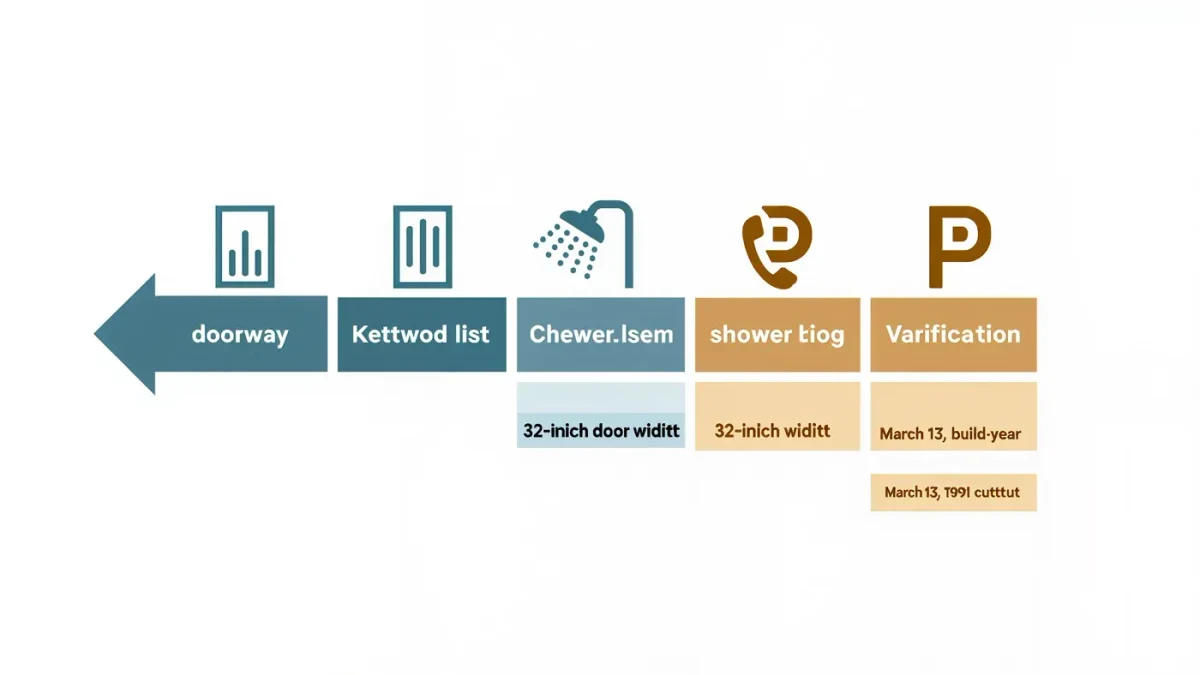
- What is the clear door width, measured with the door open 90 degrees? The number you need is 32 inches minimum.
- Is the entry zero-step, and is there an accessible route from parking or transit to the door?
- Does the bathroom have a roll-in shower or transfer tub, and are the walls reinforced for grab bars?
- Is there an accessible parking space with an access aisle, and is it assigned to the unit?
If the manager cannot answer the door-width question, that itself is information. A property with real accessible units almost always has a site plan and unit specs on file — in covered buildings, architects certified compliance with the FHA design requirements at construction.
How do you spot listing red flags?
Scammers copy real listings and swap the contact information, and accessible renters are attractive targets because supply is short. Never wire money or pay a deposit before touring in person or by video with a licensed agent, be suspicious of rents well below the market for your metro, and confirm the unit exists on the property's own website or by calling the management office on a number you looked up independently.
A second red flag is vagueness. A listing that says "handicap friendly" with no feature list, no photos of the bathroom, and no floor plan usually means a standard unit with a hopeful adjective. Ask for photos of the entry threshold, the bathroom, and the kitchen — taken for you, not from a brochure — if the listing photos skip those rooms.
What should your search setup look like?
Treat the search like a process with a paper trail. Set alerts on each platform with your keyword list, keep a simple spreadsheet of every property you contact, and log the answers to the five screening questions. When accessible units appear, they rent fast, so the preparation is what makes speed possible.
| Search channel | Best for | Watch out for |
|---|---|---|
| HUD and state housing agency databases | Subsidized and tax-credit units with documented UFAS or Section 504 accessibility | Waitlists; income limits vary by program |
| State accessible-housing registries and Centers for Independent Living | Units listed specifically as mobility-accessible | Coverage varies by state; some registries update slowly |
| Mainstream listing sites, keyword searches | Market-rate units with real features like roll-in showers | Unverified "accessible" labels; scams |
| University and medical-center housing boards | Accessible units near campuses and hospitals | Small inventory; eligibility may be tied to affiliation |
How does the build-year rule change your search?
Use the FHA's dates as a filter. Covered multifamily buildings — four or more units, first occupancy after March 13, 1991 — must meet the design requirements: accessible entrance on an accessible route, 32-inch doors, an accessible route through the unit, reachable controls, reinforced bathroom walls, and usable kitchens and bathrooms. In elevator buildings, every unit counts; without an elevator, ground-floor units count.
So when a listing shows a construction year of 1995 or later and has four or more units, the odds improve structurally, not just by luck. Buildings from 1992 or 1993 are worth extra scrutiny of records, since construction timing near the deadline caused disputes. For anything older, assume nothing and measure everything on the tour.
What if nothing is available in your area?
Where documented accessible units are scarce, two other paths exist. First, waitlists: get on them now, because they typically move by date of application, and leaving your name off a list costs you nothing but a form. Second, reasonable modifications: the Fair Housing Act gives you the right to request a modification to a unit you rent — grab bars, a lever handle, a ramp at your own expense in most cases — so an almost-right unit may become workable. A near-miss unit plus a written modification request can beat a perfect unit with a two-year waitlist, depending on your needs and budget.
What habits make the search faster over time?
Accessible rentals surface and disappear quickly, so your system matters more than any single search. Re-run saved keyword searches weekly rather than relying on one round, ask property managers to note your accessibility requirements in your file so they call you when a matching unit turns over, and keep your screening-question log updated — a property you screened six months ago may have a vacancy today, and your notes save a second call. Over a few weeks, the spreadsheet becomes the map of your market: which neighborhoods have post-1991 stock, which managers answer questions with real numbers, and which listings were words only.