Energy-saving at home works through three levers: pacing (scheduled rest before you are exhausted), positioning (doing tasks seated at the right height), and simplification (fewer steps, lighter tools, smarter storage). The CDC estimates myalgic encephalomyelitis/chronic fatigue syndrome alone affects up to 2.5 million Americans — and the same techniques, taught as pacing and work simplification, serve heart and lung conditions, arthritis, MS, and post-surgical recovery.
Spedtacular Daily Living publishes information, not medical advice. If fatigue comes from a diagnosed condition, your clinician or an occupational therapist should shape your plan — what follows is the practical home-layout side, built on the pacing and activity-management guidance published by the CDC and standard occupational therapy practice.
What is pacing, and why rest before you are tired?
Pacing means breaking the day into activity-and-rest cycles on a schedule, not on how you feel. The CDC's ME/CFS patient guidance describes pacing as staying within your energy limits to avoid post-exertional crashes — the pattern where a productive morning forces two days in bed. The same principle applies with any limited energy budget: a short planned rest after each block of effort costs less than the debt you pay when you push through.
The practical version is simple to run. Divide the day into blocks of activity and rest — many occupational therapists suggest activity spans of 20 to 30 minutes with seated or lying breaks between, though the right number is yours to tune with your care team. Stop at the scheduled rest even if you feel strong, because feeling strong mid-task is exactly when the overshoot happens. Track the day's blocks for a week; the pattern that emerges tells you which tasks to shrink, schedule, or delegate.
Which work-simplification rules cut the most effort?
Work simplification is a standard occupational therapy framework with a handful of rules that do most of the work:
- Sit to work whenever sitting is possible — it uses a fraction of the energy of standing.
- Keep tools and materials where the task happens, not where storage is convenient.
- Let gravity and water do the moving: slide pots across the counter, soak dishes instead of scrubbing, drop laundry down a chute or stairwell basket.
- Use both a light and a heavy version of daily tools — a light vacuum, a lightweight kettle.
- Stop assembling: complete one step of a task fully rather than starting three.
- Use wheels for anything heavier than a kettle — a rolling cart, a laundry trolley, a walker basket.
None of these reduces what you accomplish — the same meal gets cooked, the same laundry gets clean — they only remove the standing, carrying, and re-gripping between the useful parts.
How do you reorganize rooms so they stop costing energy?
Store things at the point of first use, between hip and shoulder height. In the kitchen that means the daily dishes, coffee, and pans in the two cabinets closest to the sink and stove; in the bathroom, towels and supplies within reach of the shower seat; in the bedroom, a week's clothing at waist height so dressing never involves floor-level reaching. Every bend eliminated is a small withdrawal that does not happen.
A seating plan matters as much as a storage plan. A sturdy chair with arms at the kitchen counter, a shower chair, a bench at the entry for shoes and coats — each converts a standing task into a seated one. If a task moves you between rooms more than twice, ask whether the task or the storage is in the wrong place. Consolidate trips: carry a basket that collects everything destined for one room, and make a single delivery instead of four.
What do you do with the heaviest household tasks?
Laundry: never carry a full basket; half-loads, a basket on wheels, or several small trips on your schedule beat one heroic haul. Sort into the machine seated, transfer wet clothes in armfuls, and use a front-load dryer at chair height where you have the option. Cleaning: rotate one zone per day on a written cycle instead of a whole-house session, and clean the bathroom right after a shower while the steam has loosened everything. Grocery shopping: a rolling cart from door to kitchen, frozen and heavy items in the first unpacking pass, and a seated rest scheduled immediately afterward rather than squeezed in later. Meal prep on good days — batch-cooking soups, chopping a week of vegetables at one seated session, freezing labeled portions — converts one strong hour into five easy dinners later in the week, which is work simplification applied to time itself.
The sequencing habit matters as much as any tool: heavy tasks never stack. A shower, a cooking session, and an errand on the same day is a plan for a crash; spread across three days with rest blocks between, the same three tasks fit inside most energy budgets.
When should equipment or help enter the picture?
When layout and pacing are not enough, the next tier is equipment — shower chairs, rolling carts, reachers, lightweight appliances, and long-handled cleaning tools, all described generically in manufacturer documentation. Beyond equipment, many conditions qualify for in-home support through programs such as Medicaid waivers or VA home-based services, each with its own stated eligibility rules — a referral to your state's assistive technology program or an area agency on aging is the usual first step, and the CDC's ME/CFS guidance encourages working with a care team on activity management rather than improvising alone.
What does a sample paced day look like?
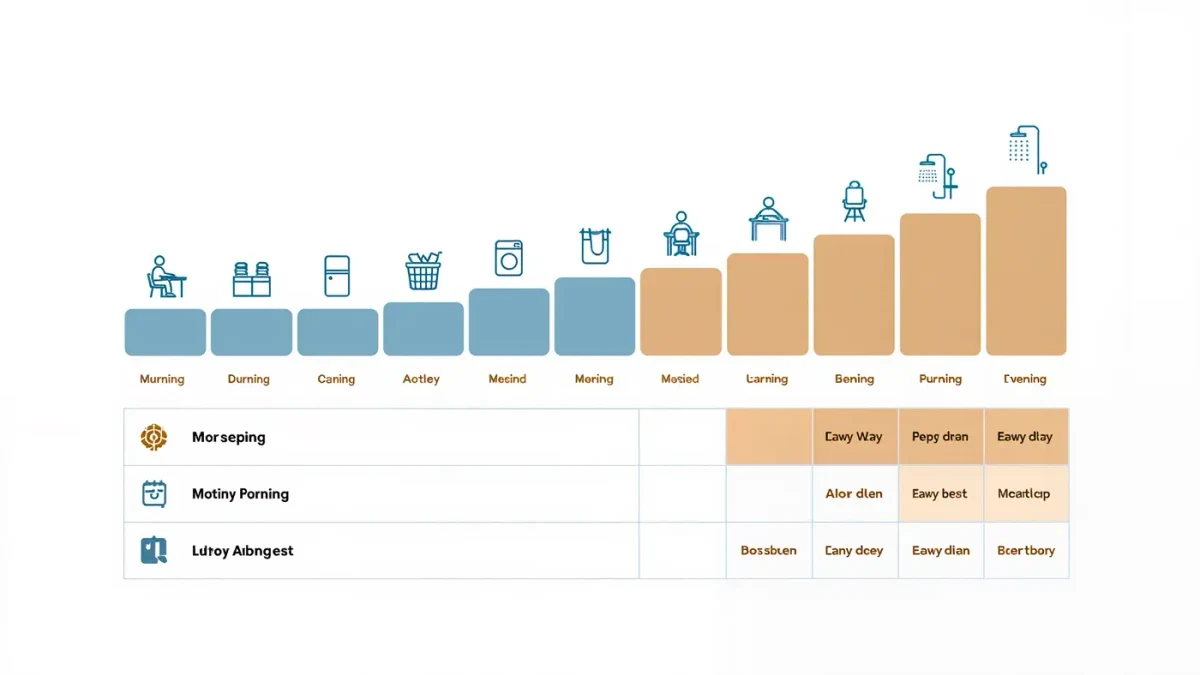
Put the pieces together and a workable pattern emerges. Morning: wash and dress seated, with a rest block before breakfast, then breakfast prepared from point-of-use storage with everything on the counter before the stove goes on. Midday: one errand or one cleaning zone, scheduled so it never follows the shower block directly, with a seated rest afterward and lunch that needs no cooking on heavy-task days. Afternoon: the low-demand hours for paperwork, calls, and reading, ideally in the chair where those tools already live. Evening: a cold or reheated meal from a batch cooked on a lighter day, clothes laid out for tomorrow, and the day's last walk-through done while energy remains.
That sample is a template, not a prescription — condition-specific plans should come from your care team. What transfers to everyone is the structure: heavy and light blocks alternate, rest is scheduled rather than earned, and tomorrow is prepared tonight while there is still budget to prepare it.
A month of tracking usually reshapes the plan. You will find two or three tasks that consume a disproportionate share of the day's energy, and those become the ones to redesign, reschedule, or hand off. Energy-saving is not doing less — it is spending the budget on the parts of the day you actually want.