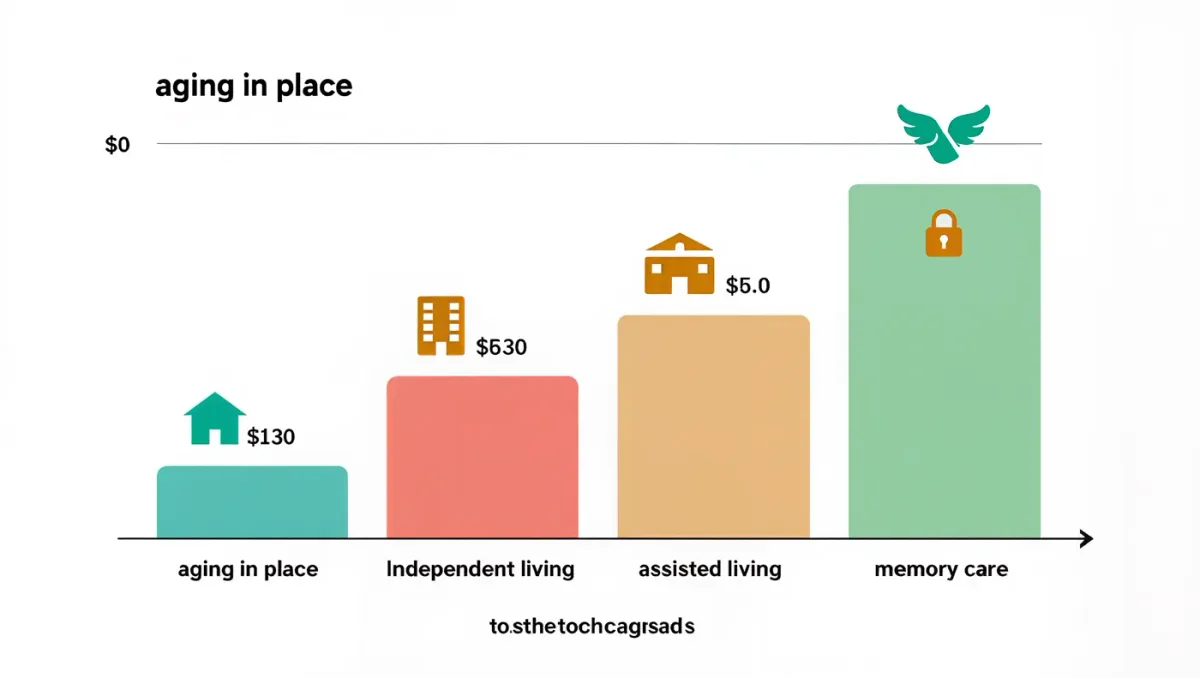
Aging in place usually costs less than senior living until paid care passes roughly 20 to 30 hours a week. Median assisted living has run above $5,000 a month, per Genworth's Cost of Care survey as of 2024, against about $33 an hour for a licensed home health aide — so the math turns on care hours, not on housing.
Costs vary sharply by region and by year, and the right housing decision depends on care needs that only you and your clinicians can assess.
What are you actually comparing?
The two options bundle costs differently, which is why headline numbers mislead. Aging in place means you keep paying housing costs — mortgage or rent, property taxes, insurance, utilities, maintenance, food, transportation — and then add care as a separate line that grows over time. Senior living, whether independent living, assisted living, or a nursing facility, bundles housing, meals, most utilities, some housekeeping, and a defined level of care into one monthly fee, sometimes with a large entry fee on top.
Neither side of the comparison is one price. The honest version is two columns of line items, compared at your actual care level.
How do the monthly cost lines compare?
The table below holds the comparison. Figures are national medians and ranges attributed to their sources with as-of dates; regional variation is large, and both columns move every year.
| Cost line | Aging in place | Senior living |
|---|---|---|
| Housing | Mortgage or rent, property taxes, insurance, utilities, maintenance — varies by home and location; owner costs commonly run 1 to 2 percent of home value per year in maintenance alone | Included in the monthly fee, typically all-in for room, meals, utilities, and housekeeping |
| Care | Added by the hour: about $33/hr for a licensed home health aide, median, per Genworth's Cost of Care survey as of 2024; 20 hrs/week is roughly $2,900/month at that rate | Included up to a defined level in assisted living (national median above $5,000/month, per the same survey); higher care tiers billed extra |
| Food | Groceries plus effort; delivery and prepared meals add cost | Meals included |
| Home modifications | One-time: bathroom rework, ramps, doorway widening — hundreds to tens of thousands of dollars depending on scope | Not your cost; the facility is built for it |
| Social and safety coverage | Added separately: medical alerts, transportation, paid companionship or adult day programs | Largely built into community life |
| Upside cap | Home equity stays yours; costs fall if care needs are low | Predictable monthly number; entry fees at some communities can be substantial and partly refundable |
Read the table with your own hours estimate in the care row. At 10 hours a week of paid help, aging in place usually wins on cash cost. At 40-plus hours, in-home care commonly exceeds assisted living's median fee — before you have paid a single housing bill.
What does aging in place really cost beyond care hours?
Homeownership costs do not pause because you need help. Property taxes and insurance keep rising in many markets. Maintenance is the line most families underestimate — roof, HVAC, and plumbing land unpredictably. Add the modification costs that make a house work: a zero-step entry, a roll-in shower, widened doorways, and the total can reach tens of thousands, though funding programs exist. The Administration for Community Living publishes a starting point for long-term services and supports planning, and veterans with service-connected disabilities may qualify for VA housing grants for modifications.
There is also the unbilled line: family care. When an adult child provides 20 hours a week of help, the cash comparison flatters aging in place. Families who count that labor honestly — in hours, in lost work, and in burnout risk — often reach a different conclusion than families who count only receipts.
What drives senior living pricing?
Independent living is cheapest because it sells convenience, not care — fees commonly run well below assisted living medians. Assisted living prices by care tier, assessed on move-in and re-assessed periodically, so the monthly fee at year three is not the fee at move-in. Memory care carries a premium over standard assisted living. Nursing facilities cost the most, with national median costs well into five figures monthly, per Genworth's Cost of Care survey as of 2024.
Ask any community three questions before comparing prices: what does the base fee include, what triggers a care-level increase and how much notice do you get, and what has the annual increase been over the past three years. The answers belong in your table.
Can funding programs change the math?
Sometimes by a lot, and always under each program's own rules. Medicaid home- and community-based services waivers can pay for in-home care and modifications for people who meet both functional and financial eligibility as their state defines it — which can keep aging in place viable when private care hours would be unaffordable. The VA's SHA and SAH grants help eligible veterans with service-connected disabilities modify homes, per the VA's published grant rules. Some states and area agencies on aging fund smaller modification grants, typically a few thousand dollars, with income criteria and waitlists.
On the senior living side, Medicaid does not pay for room and board in assisted living, and its coverage of that setting varies by state program; long-term care insurance, where it exists, is the other major offset. The comparison that matters is the one run after you know which programs you actually qualify for — never before.
Where do families usually get the math wrong?
- Comparing the assisted living fee against the mortgage payment instead of the full housing cost line — taxes, insurance, utilities, food, and maintenance belong on the aging-in-place side.
- Assuming care hours stay flat. Care needs usually grow, and the cost curve bends up years before anyone plans for it.
- Forgetting the sale side. Selling a home releases equity and eliminates maintenance; staying keeps both. Neither is free.
- Using national medians for a local decision. Both Genworth's survey and facility pricing vary by metro; get local figures.
- Treating today's numbers as permanent. Both columns have risen every year in recent surveys — budget with current-year local quotes, not last year's brochure.
How do you run the comparison for your own situation?
- Estimate current weekly paid and unpaid care hours, and get a realistic projection from your care team.
- Price 10, 20, and 40 hours a week of local home care at local rates.
- Total your monthly housing costs from a year of statements — taxes, insurance, utilities, maintenance, food, transport.
- Get written base fees and care-tier pricing from at least three local communities.
- Add one-time lines: modifications on one side, entry fees on the other.
- Re-run the totals at higher care hours. The option that wins at 10 hours often loses at 40.
The exercise is not about finding the cheapest option. It is about knowing when the crossover arrives, so the decision gets made deliberately instead of in a crisis.