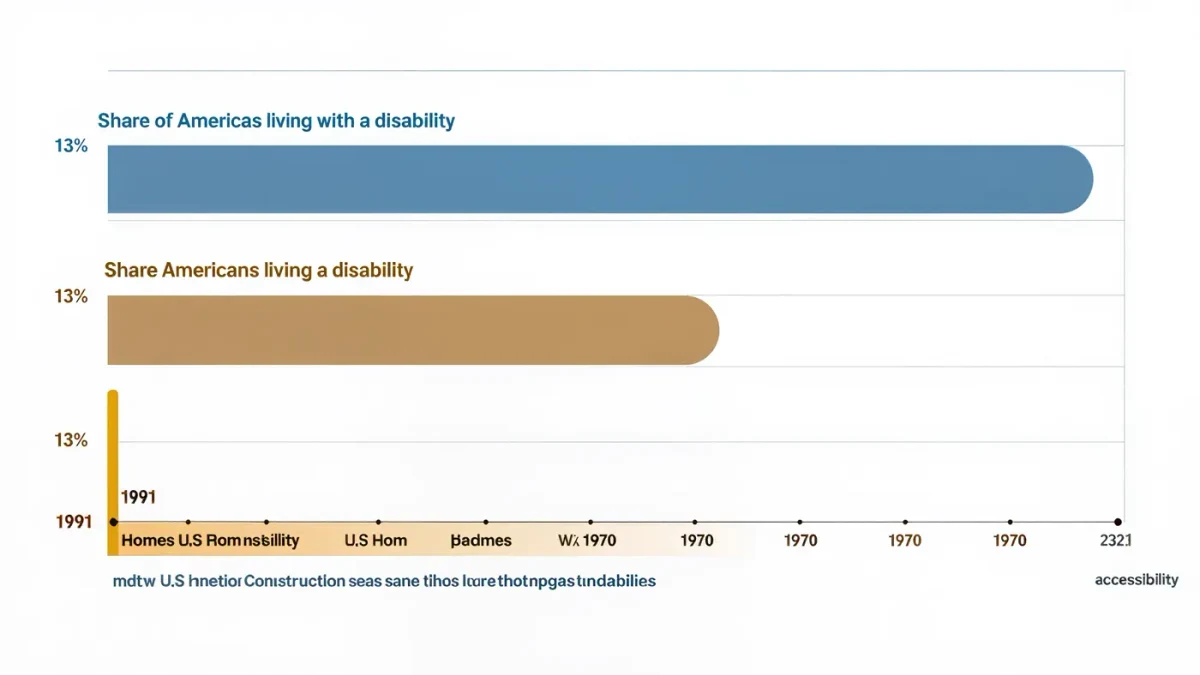
The United States has far too few accessible homes. Roughly 13 percent of Americans live with a disability, per Census Bureau American Community Survey data as of recent years, while research estimates place the share of homes with basic wheelchair usability — zero-step entry, wide doors, a usable main-floor bath — in the low single digits.
Program rules and data cited here carry their as-of dates, and housing markets vary sharply by region.
Why did the stock get built this way?
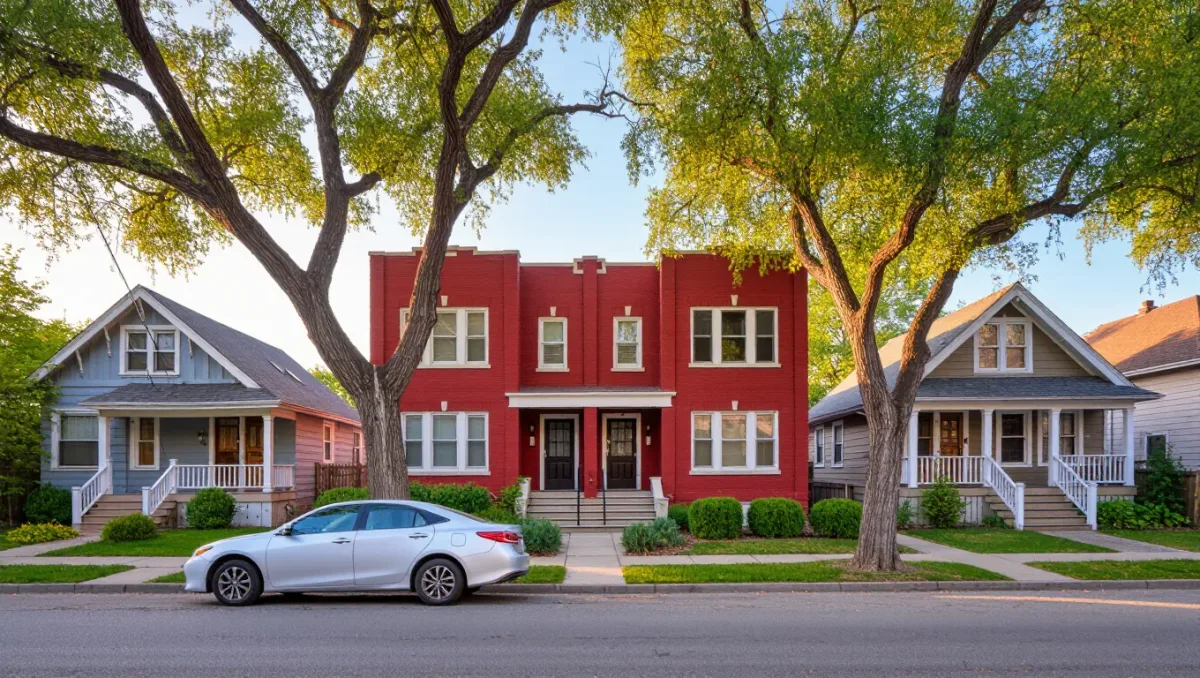
Most American homes were built before accessibility thinking reached building practice. The median U.S. home was built in the late 1970s, per Census Bureau housing stock data — decades before the Fair Housing Act design requirements took effect for multifamily buildings first occupied after March 13, 1991. The FHA requirements never applied to detached houses, and still do not. So the stock reflects its era: steps at every entry, 28- and 30-inch interior doors, and bathrooms sized for nobody's turning circle.
Newer multifamily construction carries the FHA's seven requirements in covered buildings — accessible entrance and route, usable doors, reachable controls, reinforced bathroom walls, usable kitchens and baths — but those minimums cover only some units in some buildings, and single-family construction, the largest part of the market, builds to no accessibility standard at all outside a scatter of local visitability ordinances.
How big is the mismatch between need and supply?
On the need side, the Census Bureau's American Community Survey has put disability prevalence at roughly 13 percent of the population, rising sharply with age — and the population is aging. On the supply side, the federal government does not maintain a national count of wheelchair-usable homes, which is itself part of the problem: researchers and advocacy organizations have filled the gap with estimates that consistently land in the low single digits of the national stock.
Two comparisons frame the shortage. First, for every home built with accessibility in mind, many more households include someone who could use it — a wheelchair or walker user, an older adult with limited mobility, a person recovering from surgery or a stroke. Second, accessible units that do exist in subsidized housing are scarce enough that waitlists for them are commonly measured in years; waitlist lengths vary by housing authority, but the pattern of long waits for accessible units repeats across public housing programs administered under HUD rules.
What does the shortage look like in practice?
- Search filters: mainstream listing sites let you filter by square footage or pet policy more easily than by zero-step entry or door width, and listing agents often cannot answer accessibility questions about their own listings.
- Retrofit economics: turning a stepped, narrow-doored house into a usable one costs tens of thousands in typical cases — money renters do not control and many owners do not have.
- Institutional bottlenecks: accessible subsidized units exist — HUD's rental assistance programs require a percentage of units to meet accessibility standards in covered developments — but the wait for a voucher and the wait for an accessible unit compound each other.
- Geography: the shortage concentrates where the stock is oldest — Northeast and Midwest cities with prewar housing — while Sun Belt construction adds accessible-adjacent features like single-floor living more often, though usually without meeting any standard.
Why doesn't the market just build more of them?
Incentives point the other way. Builders sell to the median buyer, and accessibility features are marketed as universal conveniences rather than specified to dimensions. Landlords face no retrofit mandate for existing buildings — the FHA design requirements applied at construction, not after — so the accessible stock grows only as fast as new covered construction, minus demolitions. Appraisal practice has historically struggled to value accessibility, which weakens the owner's case for investing in it. And the households who most need accessible homes disproportionately have lower incomes, which means less effective demand at the price points where new construction happens.
The result is a slow-accumulating shortage: not a crisis event, but a persistent mismatch that families run into one at a time, usually during a hospital discharge or a parent's decline, when the timeline is shortest.
What is being done about it?
Policy has moved at the edges. Several cities and a few states have adopted visitability requirements for new subsidized or even market-rate single-family construction — zero-step entry, wide main-floor doors, a main-floor bath — following the visitability movement's three-feature model. Federal fair housing enforcement, through HUD and the Department of Justice, has produced settlements requiring accessible units be built where the FHA design requirements were skipped. Advocacy organizations continue to push home modification funding, because the fastest way to add an accessible home to the stock is to fix one that already exists.
The arithmetic of the fix is slow either way. New construction adds roughly one percent to the housing stock in a good year, so even if every new home were visitable, the existing stock would dominate for decades. That is why retrofit funding, accessible-unit set-asides in assisted housing, and visitability ordinances all matter at once.
Who is hit hardest by the gap?
The shortage is not evenly distributed. Renters feel it first, because they cannot retrofit and must instead compete for the rare listing that already works — and accessible features, when a rental has them, often carry a rent premium. Low-income households feel it next, since accessible units in the private market skew newer and costlier, while subsidized accessible units are the scarce, waitlisted ones. Rural households face a thin market on top of everything: few listings at all, fewer accessible ones, and modification contractors hours away. Older adults encounter the gap as a moving problem — the house that worked at 65 stops working at 80, and the accessible options within the same community may number in the single digits. Each group meets the same underlying statistic from a different direction.
What can you do while the shortage persists?
- Search by dimensions, not labels: ask every listing agent for door clear widths, entry steps, and bath size — measurements, not the word "accessible."
- Get on more than one waitlist: public housing, voucher, and accessible-unit lists run separately, per each housing authority's rules; HUD's rental assistance pages explain the programs.
- Check modification funding early: state and local programs, Medicaid waivers where eligible, and VA grants for eligible veterans each fund part of the cost under their own rules.
- Advocate at the permit level: visitability ordinances get adopted city by city, and public comment periods are where they are shaped.
The shortage is not a fact of nature. It is the accumulated result of decades of building to no standard — and it unwinds the same way, one door width at a time.