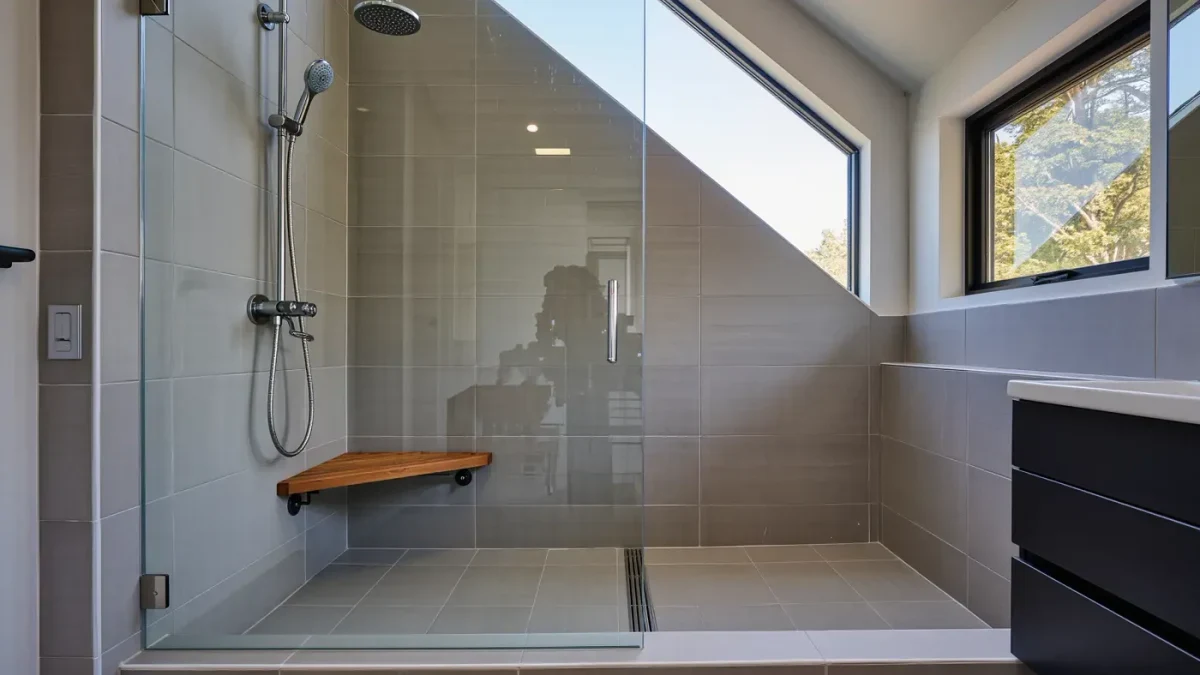
A walk-in tub typically costs $2,500–$8,000 installed and a roll-in shower $3,000–$15,000, as of 2025 industry pricing ranges — but access matters more than price. A walk-in tub is for people who can transfer across a low threshold and want to soak; a roll-in shower sized to the ADA 2010 Standards' 30-by-60-inch minimum serves people who bathe seated.
What does each option actually give you?
A walk-in tub has a watertight door in the shell, a low threshold (typically 3–8 inches, versus a standard tub rim near 20), an interior seat at chair height, and often jetted or air features. You step or pivot across the threshold, sit, close the door, and fill. A roll-in shower — also called a barrier-free or zero-entry shower — removes the curb entirely so a wheelchair can roll in or a shower chair can slide in; the space gets a slope to a center or trench drain, a handheld showerhead, and a fold-down or wheeled seat.
The functional difference in one sentence: the tub is for soaking but you sit inside it while it fills and drains; the shower is for washing quickly but you give up soaking. Some households solve this with a tub-shower combination, if the bathroom has room.
How do the costs and features compare?
| Factor | Walk-in tub | Roll-in shower |
|---|---|---|
| Typical installed cost (2025) | $2,500–$8,000; soaker models at the low end, jetted/air models higher | $3,000–$15,000; prefab kits lower, full tile conversions higher |
| Access method | Step or pivot over a 3–8 inch threshold; seated inside | Curb-free roll-in; shower chair or wheelchair (30x60 in. minimum per ADA 2010 Standards sec. 608, in public settings) |
| Time to use | Fill time of 10–15 minutes before entering; you sit while tub drains before exiting | Immediate |
| Soaking / therapeutic value | Yes — full immersion | No |
| Space taken | Similar footprint to a standard tub | Can fit smaller footprints; conversion often opens the room |
| Plumbing work | Moderate; may need upgraded water heater for fill speed | Extensive — drain relocation and floor sloping |
| Caregiver assistance | Harder — reaching into a tub shell | Easier — open access from multiple sides |
Costs vary by region and bathroom condition, so treat those ranges as planning figures and collect two or three itemized quotes.
Which one is safer for transfers?
Neither is automatically safer — the safer one is the one that matches your transfer. The walk-in tub's low threshold is far easier than a 20-inch tub rim, but you still cross it twice per bath, and you must sit inside while it fills and drains, which some people find long and cold. If you cannot safely make a standing pivot to a seat, the door does not solve the problem. The roll-in shower removes the crossing entirely: a wheeled shower chair rolls over the threshold, or a fixed seat lets you transfer sideways with nothing to step over. Standards for public buildings reflect this — the ADA 2010 Standards, section 608, set the 30-by-60-inch roll-in shower dimensions and flush threshold rules, while transfer showers with a seat are a separate listed type. ANSI A117.1 carries parallel figures for buildings covered by code.
For balance context: the CDC reports that about one in four U.S. adults 65 and older falls each year, and bathrooms are among the highest-risk rooms. Whichever enclosure you choose, add grab bars at 33–36 inches per the same standards, a handheld shower, and non-slip flooring — those details prevent more injuries than the tub-versus-shower decision itself.
What should you ask before signing a contract?
- Can you transfer to a chair-height seat and wait through fill and drain? If no, lean roll-in shower. Have an OT confirm the answer rather than guessing.
- Does your water heater refill fast enough? Walk-in tubs use 40–60 gallons; ask the dealer for the model's capacity and check your tank size before purchase.
- Who pays for the drain and slope work? For showers, floor re-pitching is the cost driver — make sure quotes include it, not just the kit.
- What does the warranty cover, and who services it? Door seals and pump motors are the common walk-in tub repairs; confirm parts and labor terms in writing.
- Is funding available? Some Medicaid waivers and VA grants cover bathroom modifications for people who meet each program's eligibility rules; check the program's own published terms.
- What is the timeline? Prefab walk-in tubs and shower kits often install in one to three days; full tile roll-in conversions commonly run several days to a week, per dealer schedules as of 2025.
Can you have both?
In a large bathroom, yes — a roll-in shower beside a compact walk-in tub, or a wet-room layout that makes the whole floor drain. The combined project typically lands at the top of both ranges combined, $10,000–$20,000 and up as of 2025, but it removes the trade-off. In small bathrooms, the more common compromise is a walk-in tub with an overhead shower attachment, or a transfer shower with a fold-down seat — each covers part of the other's function.
What details make either option work well?
Whichever enclosure you choose, the finishing details decide whether it gets used daily or avoided. For roll-in showers, the non-negotiables are a handheld showerhead on a slide bar mounted between 38 and 48 inches so it works seated or standing, a folding seat or a wheeled shower chair that fits the space, a floor sloped to the drain without pooling, and grab bars on the walls you actually push from. For walk-in tubs, look for a quick-drain option or a second drain, because sitting through a slow drain is the most common complaint owners raise; a heated seat and back help during winter fills, and a handheld shower lets you rinse without waiting for the full soak.
In both cases, thermostatic mixing valves that cap water temperature matter — scald risk rises for anyone with reduced sensation, and plumbing codes in most jurisdictions require anti-scald protection on new tub and shower fittings. Ask your installer which valve goes in and whether it meets the local code, and get it in the written scope.
Frequently asked questions
Is a walk-in tub or roll-in shower better for a wheelchair user?
A roll-in shower, in most cases. It allows a wheeled shower chair or a lateral transfer with no threshold to cross, and the ADA 2010 Standards' 30-by-60-inch roll-in dimensions exist precisely for wheeled use. Walk-in tubs still require a standing or seated pivot across the threshold.
Do walk-in tubs raise the water bill?
They use more water per bath than a shower — commonly 40–60 gallons per soak, per manufacturer specifications. Frequent soaks increase water-heating costs noticeably, so check your water heater capacity before buying.
Which costs less to install?
Walk-in tubs often cost less — $2,500–$8,000 installed versus $3,000–$15,000 for roll-in showers as of 2025 — because shower conversions involve drain relocation and floor sloping. Prefab shower kits narrow the gap.