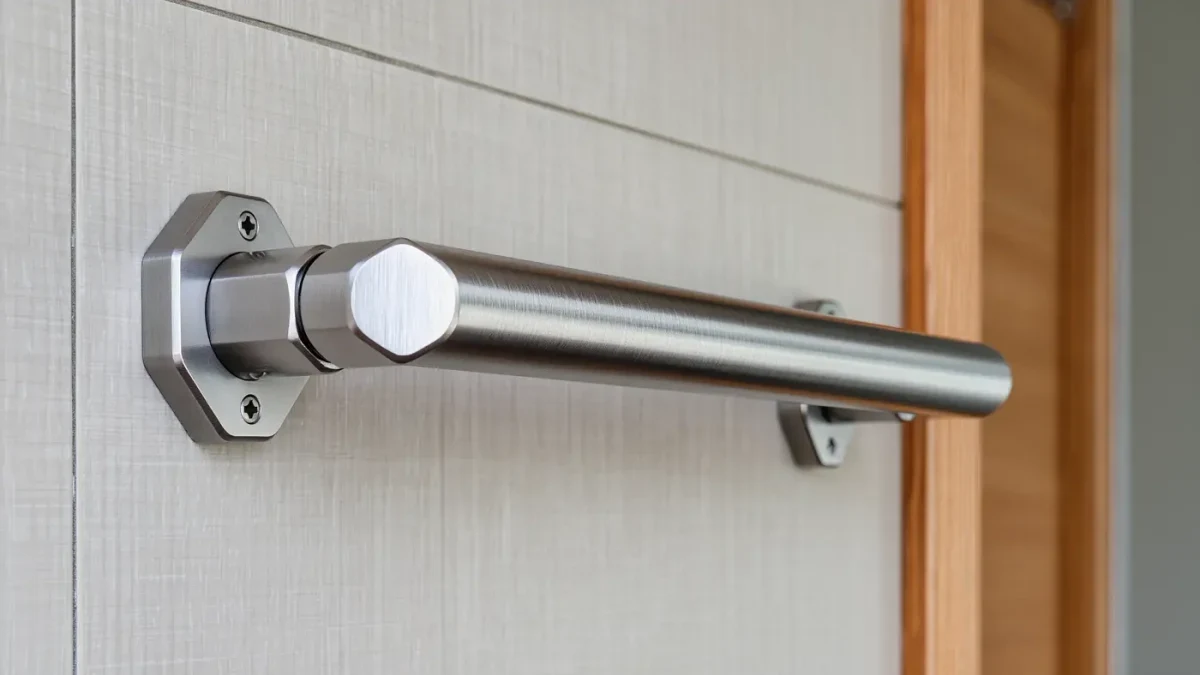
For toilets, the ADA 2010 Standards set grab bar heights between 33 and 36 inches above the floor, measured to the top of the gripping surface. Those figures govern public buildings, not your bathroom — but ANSI A117.1, the standard many local building codes adopt, uses the same range, making it the best-researched starting point for a home install.
One note before the dimensions: Spedtacular Daily Living publishes information, not medical or construction advice. A physical or occupational therapist can recommend placement for your specific body and routine, and a licensed contractor should handle anchoring.
Why the ADA range starts at 33 inches — and where it applies
The 33-to-36-inch band exists because it overlaps the range where most adults can push down on a bar while seated and pull up while standing. Under the ADA 2010 Standards, that height applies to grab bars at accessible toilets, showers, and tubs in public accommodations and government facilities — hotels, hospitals, airports, restaurants. Your house is governed instead by your local building code, and many codes base their accessible-design sections on ANSI A117.1, which likewise specifies 33 to 36 inches to the top of the gripping surface.
The distinction matters in two directions. If you are modifying a private home, you are free to mount a bar at 38 inches because that is where your shoulder sits — nothing in federal law stops you. If you are a landlord renovating an apartment, different rules can apply: the Fair Housing Act design requirements cover grab bar reinforcing in bathrooms of covered multifamily buildings, so there is blocking in the wall even when no bar is installed. When in doubt, check with your local building department before cutting into tile.
What height should you actually mount at?
A practical rule from rehab practice: the bar should sit at or slightly above your wrist when you stand with your arms relaxed. For many people that lands between 34 and 38 inches. The ADA range of 33–36 inches (2010 Standards, sections 604.5 and 609.4) is the default starting point; adjust from there for your height, your transfer technique, and whether you push or pull more.
- Standard starting point: 33–36 inches to the top of the bar, per ADA 2010 Standards and ANSI A117.1.
- Shorter adults or wheelchair users who pull up: closer to 33 inches often works better.
- Taller adults or anyone who pushes down to stand: 36–38 inches is common — legal in a home even though a public building would have to stay inside the range.
- Ask an OT: an occupational therapist can watch your actual transfer and mark the wall. That mark beats any chart.
Placement behind and beside the toilet
Behind the toilet, the ADA 2010 Standards call for a 36-inch-wide horizontal bar centered on the water closet, with the bar's centerline 12 inches from the wall on the open side — a distance ANSI A117.1 matches for its side-wall bar. On the side wall, the standard specifies a 42-inch bar starting no more than 12 inches from the rear wall and extending at least 54 inches from it where space allows. In a tight home bathroom you may not have 42 inches of side wall; a shorter bar mounted at the right height still does the job, and a vertical bar added near the shoulder helps with the final stand-up push.
For a home install, the two-bar pattern is the one worth copying: one horizontal bar on the open side at 33–36 inches, and either a second bar on the tank wall or a vertical bar at the front edge of where you sit. Two points of contact beat one, especially on days when your strength is uneven.
Placement in showers and tubs
In a roll-in or walk-in shower, the standards place a horizontal bar on the side wall and, in transfer showers, a bar that wraps around three walls at 33–36 inches, per the ADA 2010 Standards, section 608. For a tub, the pattern is a pair of horizontal bars on the long wall: one at 33–36 inches for sitting and rising, and a lower one around 9 to 11 inches above the tub rim for lowering into the water. ANSI A117.1 shows the same two-bar tub arrangement in its referenced figures.
Two home-specific adjustments are worth making. If you use a shower chair, put the bar where your hand naturally reaches while seated — sometimes a few inches lower than the standard height. And if you step over a tub rim, consider adding a vertical bar on the short wall at the transfer point; standards require vertical bars in some public settings, but in homes they are simply a smart addition at whatever height your grasp lands.
How do you anchor a grab bar so it holds?
The bar is only as strong as what is behind it. The ADA 2010 Standards, section 609.8, require grab bars and their mounting surfaces to withstand 250 pounds of force applied in any direction — that number is your target at home, too, even where no inspector will check. Follow these steps:
- Find the framing. Use a stud finder to locate wall studs; solid blocking or studs behind the full length of the bar are what carry the load. Hollow-wall anchors rated for the weight are a fallback, never the first choice in tile.
- Add blocking if the studs don't line up. Opening the wall to add 2x lumber between studs costs more but is the difference between a bar that holds for decades and one that pulls out under load.
- Mark height from the floor, not the tile line. Measure 33–36 inches (or your OT's mark) to the top of the gripping surface, not the center of the screw holes — manufacturers measure differently, so check the template.
- Drill, seal, mount. Use the manufacturer's hardware, set screws into blocking, and seal penetrations in wet areas with silicone to protect the wall behind tile.
- Load-test before you trust it. Pull hard with your hands before putting your full weight on it. If anything flexes, remount it.
What does installation cost?
As of 2025, typical installed costs run about $100–$300 per bar when backing is already in place, and roughly $500–$1,000 for a bathroom set of two or three bars where tile needs drilling and blocking added, based on ranges commonly reported by home-services pricing sources such as Angi and HomeAdvisor. Metal bars alone commonly run $20–$100 depending on length and finish; nylon-coated and stainless options sit at the higher end. Prices vary by region and wall condition, so treat those as planning figures and get two or three quotes.
If the budget is tight, prioritize the toilet transfer first — it is the highest-risk moment in most bathrooms. The U.S. Centers for Disease Control and Prevention report that about one in four adults 65 and older falls each year, and bathrooms account for a large share of home falls. A single well-placed bar at the toilet addresses the most common transfer in the room.
Frequently asked questions
Are towel bars ever acceptable as grab bars?
No. Towel bars are decorative hardware anchored for the weight of a towel, not 250 pounds of force. Some manufacturers make grab bars that double as towel bars — those are fine, because the bar and its anchors are rated for body weight, unlike a standard towel bar.
Do grab bars work on tile walls?
Yes, when screwed into blocking or studs behind the tile, using a diamond bit and silicone-sealed penetrations. Tile itself is not the anchor; what is behind it is. Anchors rated for hollow tile exist, but blocking is the reliable method.
Where does the 33–36 inch rule come from?
From the ADA 2010 Standards, section 609.4, and ANSI A117.1, which are public-building and multifamily standards. Homes are governed by local codes, which often do not require grab bars at all — the numbers are a researched starting point you can adjust for your body.
Can you install grab bars in a rental?
Usually yes, and the Fair Housing Act generally requires landlords to allow reasonable modifications by tenants with disabilities, at the tenant's expense in most cases; some landlords ask that bars be removed or left at move-out. Get the agreement in writing before drilling.