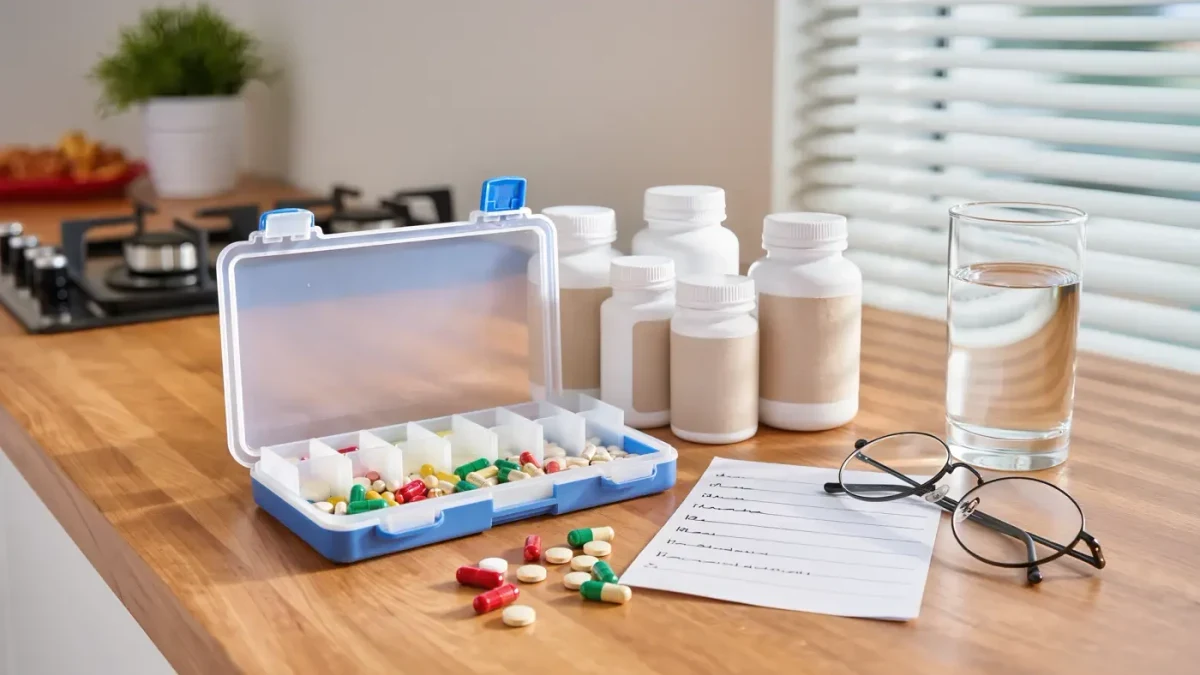
You can manage a medication schedule at home with three tools working together: one consolidated list of everything you take, a weekly or monthly pill organizer filled on the same day each week, and a reminder system tied to a habit you already have. The FDA's safe-use guidance is direct about the stakes — take medicine exactly as prescribed, keep it in its original labeled container until you fill your organizer, and review the full list with your doctor or pharmacist at every visit.
Nothing here changes what your prescriber ordered; this guide covers the routines, storage rules, and equipment that keep a schedule you and your clinician have already set.
Why do medication schedules fail at home?
Most schedule failures are system failures, not memory failures. The FDA and patient-safety groups point to a short list of recurring causes: similar-looking pills in similar bottles, schedules that change after a hospital stay or telehealth visit, bottles stored in different rooms, and instructions written in language that does not match how you actually live — "twice daily" is not the same as "with breakfast and dinner" unless you decide it is.
Each failure has a structural fix. Consolidation fixes scattered bottles. A single filling ritual fixes the weekly chaos of opening five bottles a day. A written or digital record fixes the changes that happen when a dose is adjusted and nobody tells the pharmacist. You are not fixing yourself; you are fixing the system around you.
What should you do first?
Start with a full medication inventory, and do it in one sitting.
- Collect every bottle — prescriptions, over-the-counter drugs, vitamins, supplements, drops, inhalers, and anything sampled from a clinic. Include products from every cabinet and bag.
- Write one list with five columns for each item: name, dose, times per day, purpose, and prescribing clinician. The FDA's medication-safe-use materials recommend keeping this list current and bringing it to appointments.
- Flag the conflicts — duplicate ingredients across prescriptions and over-the-counter products, and any bottle past its expiration date. Bring the flags to your pharmacist, not to an internet search.
- Set the schedule in your own words. "8 a.m. with food, 8 p.m. with food" beats "twice daily" on a wall chart.
- Store it where decisions happen. One list on the refrigerator, one photo of it on your phone, one copy with a family member or neighbor who helps in an emergency.
Which pill organizer fits your schedule?
Match the organizer to the number of doses, not to the packaging that looked simplest on the shelf.
| Organizer type | Best for | Trade-offs |
|---|---|---|
| Weekly AM/PM (14 slots) | Once- or twice-daily schedules | Small, portable, needs refilling weekly |
| Weekly 4-times-day (28 slots) | Complex schedules, morning-noon-evening-bed routines | Larger; slots are small for big tablets |
| Monthly blister packs from a pharmacy | Schedules that change rarely | Pharmacy prepares it; ask about cost and whether your pharmacy offers it |
| Tamper-resistant locked organizers | Homes with children, visitors, or memory-support needs | Slower to open; some have timed locks |
If a medication changes mid-week, the FDA's advice against keeping drugs in unmarked containers matters twice over for organizers: refill from the labeled bottle, and never leave loose tablets in a pocket or purse without a labeled container.
How do you build a reminder system that actually works?
Anchor every dose to something you already do without prompting — coffee, a meal, brushing teeth, feeding a pet. Behavioral researchers call this habit stacking; pharmacists just call it taking pills with breakfast. Layer two reminder types so a single failure does not cascade:
- Auditory or on-screen: phone alarms labeled with the drug name and dose, or a medical reminder app. Set alarms at the actual clock times you chose, not the bottle's vague interval.
- Visual: the organizer itself is the second reminder — an empty Tuesday-morning slot tells you the dose is done, which paper charts cannot do.
- Human backup: a family member, roommate, or neighbor who receives a text when a critical dose is marked done. Several states also offer telephone check-in programs for people who live alone; your Area Agency on Aging can tell you what operates locally.
Where should medications live in your home?
Storage is an accessibility question and a safety question at once. The FDA's storage guidance draws a hard line: most medicines belong in a cool, dry place, and the bathroom medicine cabinet — steam, heat, humidity — is one of the worst spots in the house for tablets and capsules. Some drugs need refrigeration; the label or your pharmacist settles it.
For accessible storage, keep the daily organizer between hip and shoulder height on a fixed shelf, not stacked in a drawer you have to empty to reach. If you use a wheelchair, a wall-mounted shelf next to where you eat breakfast beats any cabinet. If low vision is part of the picture, high-contrast tactile bumps on organizer lids and a large-print dose chart turn a memory task back into a reading task.
What changes after a hospital stay or dose change?
Transitions are where schedules break. Before you leave any hospital, clinic, or emergency visit, ask three questions: What changed? What stopped? What is new? Then rebuild the list the same day, refill the organizer from scratch, and move any discontinued drug out of the active shelf — the FDA's disposal guidance recommends drug take-back sites as the first choice, with pharmacy and law-enforcement collection points listed by the U.S. Drug Enforcement Administration's periodic take-back events.
What is the weekly review routine?
Once a week, on the same day, spend ten minutes on four checks:
- Count remaining tablets against refills due before next week; call the pharmacy before you run out, not after.
- Compare the organizer contents to the list — this catches a stopped drug still being filled.
- Scan for expires, duplicates, and unlabeled containers.
- Log anything that felt off — a skipped dose, a side effect, a timing problem — in one note you bring to the next appointment.
Ten minutes a week is the difference between a schedule you trust and a shelf you guess about. The system above is the system pharmacists and the FDA's own safe-use materials keep describing: one list, one organizer, reminders anchored to real life, and a standing review. Build it once, then maintain it.
How do you keep the whole household in sync?
If a spouse, roommate, or personal attendant shares the schedule, the system needs one source of truth, not two parallel ones. Keep the master list in one place — the refrigerator copy is the classic because everyone passes it — and agree that changes get written there the day they happen. Attendants and family helpers should fill the organizer only from the current list, and initial the weekly checklist so you can see at a glance who did what. For people who use personal assistance services, walking a new attendant through the system once, in the room where it lives, prevents most first-month errors.