An accessible playground needs three things to come out right: a surface wheelchair users can travel on, equipment reachable by ramp or transfer, and play components at heights a seated child can use. The technical baseline is the U.S. Access Board's guide to the ADA standards for play areas, which sets requirements like at least one of each type of ground-level play component and ramp access to elevated components in larger structures.
Accessibility requirements for a specific playground depend on when it was built or altered and on which jurisdiction owns it.
Why this is a guide rather than a roundup of 2026 announcements
As of February 23, 2026, we could not verify a specific, dated accessible-playground grant award or project launch from official sources in time for this piece. Inventing one would serve nobody. What we can do is show how projects actually get funded and built, so you can judge the announcements in your own area when they appear — or start one yourself.
What makes a playground accessible under the standards?
The Access Board's play-area guide, which implements sections 240 and 1008 of the 2010 ADA Standards, covers both new construction and alterations. Key points:
- Ground-level components. Where a play area has 25 or more components, at least 5 percent of each type must be on an accessible route at ground level — swings, spring toys, panels.
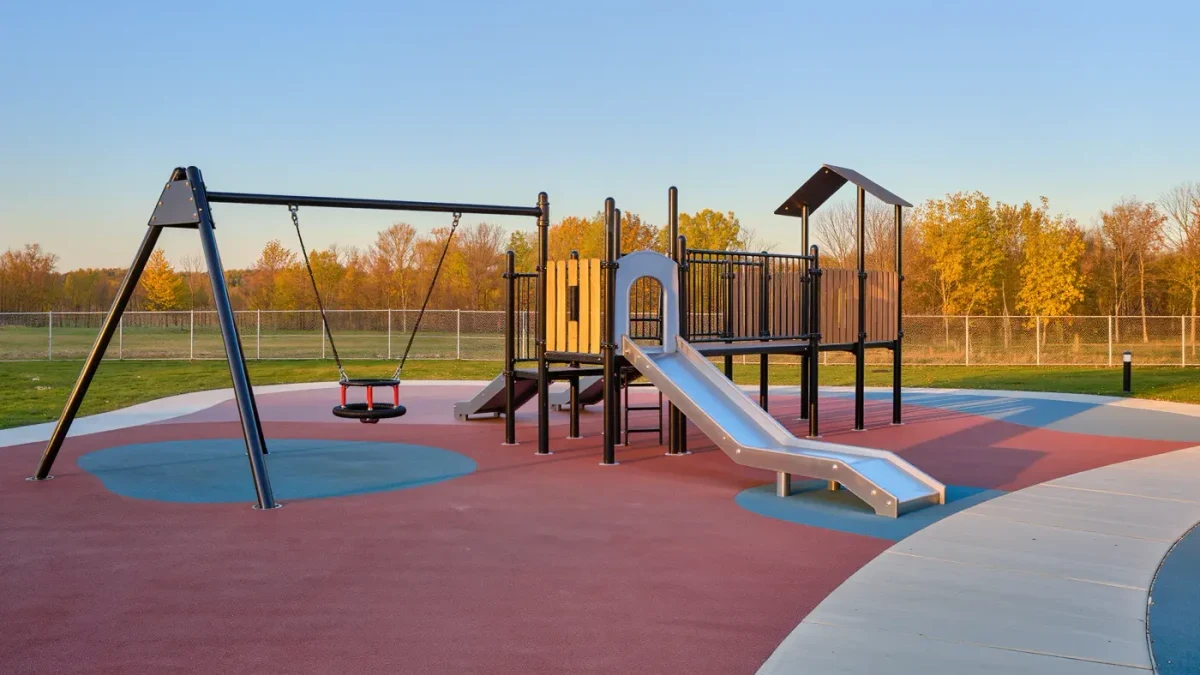
- Elevated components. Play structures with 20 or more elevated components need ramps to at least 25 percent of them; smaller structures can use transfer systems instead.
- Surfaces. Accessible routes within the play area must be firm, stable, and slip resistant — engineered wood fiber only counts when installed and maintained to spec, which is why poured rubber and turf systems dominate new builds.
- Clear floor space and reach ranges. Each component needs wheelchair turning and approach space, with operable parts within reach ranges set by the standard.
Where does the money for these projects come from?
Accessible playgrounds in the United States are typically paid for by stacking three or four sources:
- Park district and municipal capital budgets. The most reliable stream. When a city replaces aging equipment, ADA obligations push the replacement toward inclusive design — the cheapest moment to build access in.
- State grants. Many state park, natural resources, and health departments run outdoor-recreation grant cycles that fund inclusive equipment. Your state's grants portal is the place to check, and cycles often open in late winter with spring deadlines.
- Private foundations and service clubs. Community foundations, playground-equipment makers' foundations, and Rotary or Lions clubs commonly fundraise the gap for sensory panels, adaptive swings, and surfacing upgrades.
- School district funds. Districts can use some federal education money for playgrounds when the equipment serves instructional or inclusion goals; PTO fundraising carries many school projects.
How much does an accessible playground cost?
Costs scale with surfacing more than equipment. A single adaptive swing or spinner runs a few thousand dollars; a full inclusive structure with poured-in-place rubber surfacing for a public park commonly reaches into the hundreds of thousands, with surfacing alone often a quarter of the budget. That surfacing share is the detail most fundraising campaigns underestimate — and the line item that decides whether a wheelchair user can actually use the result.
How could you start one in your community?
A workable sequence:
- Ask the parks department which playground is scheduled for replacement soonest — riding an existing capital plan beats starting from zero.
- Organize parents and disabled community members, and get the ask on a park board agenda during public comment.
- Get a written cost estimate that separates equipment, surfacing, and site work.
- Match the project to funders: municipality for the base, state grant cycles and foundations for the inclusive additions.
- Keep maintenance on the record — surfacing that isn't maintained stops being accessible, and the standard's value fades with it.
What about sensory accessibility?
Physical access is only half of inclusive design. Many projects now add quiet zones, sensory panels, and fencing with gates that contain runners — features that matter for autistic children and are fundable under the same grants. The Access Board's play-area guide also requires that where a facility provides at least one of each type of ground-level component, some of each type must serve children with different disabilities, not just wheelchair users. When a design pairs a ramped structure with a fenced sensory garden and ground-level panels at seated reach, it is working from the full standard, not the narrow version.
Funding committees respond to numbers a campaign brings: how many children in the district use mobility equipment, how many families travel to the next town for an accessible playground, how far that is. School districts and park boards keep the first figure; parent networks collect the rest.
What should you check when a project is announced near you?
Look past the word inclusive in the press release. Ask three questions: Is the surfacing poured rubber or maintained engineered fiber? Does the elevated structure use ramps, or only a transfer system? Are there ground-level components of every type — swings included — on the accessible route? A project that fails any of the three may still be an improvement, but it is not the standard the Access Board describes.