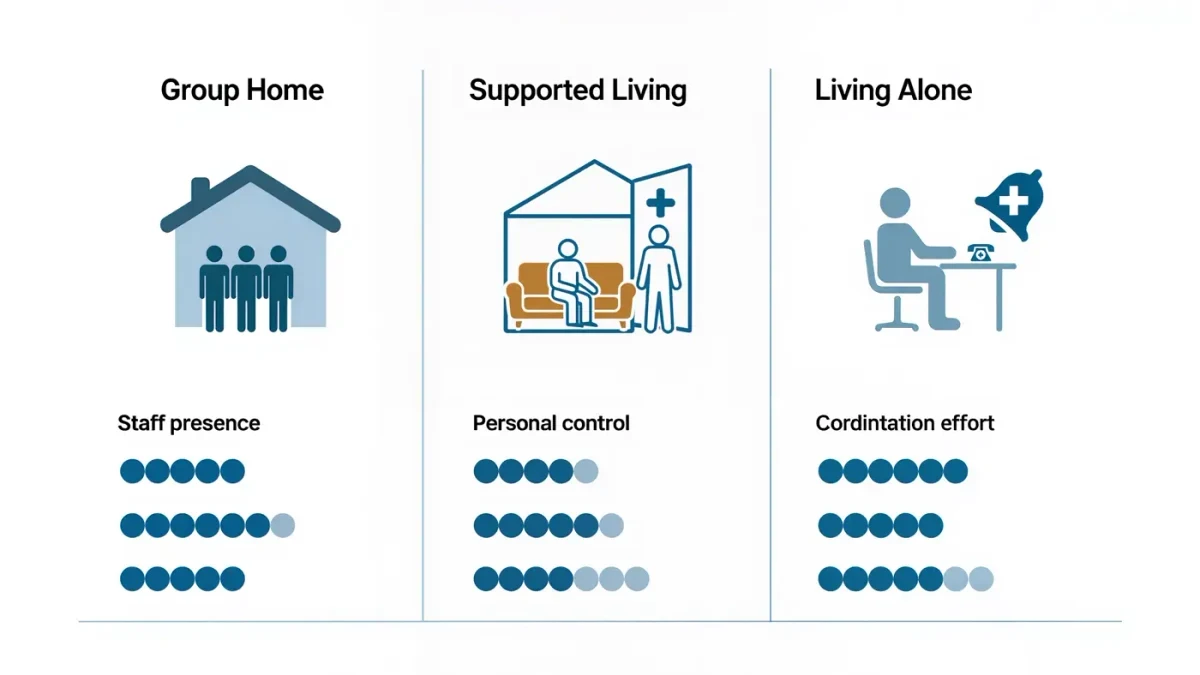
The three main options for living with support differ on one axis more than any other: control. In a group home, staff and services are built into a shared residence you join; in supported living, you hold your own home or apartment and services come to you; living alone means arranging paid or informal support yourself, without a program structuring your day. How each is paid also differs sharply — group homes and supported living are typically funded through Medicaid home and community-based services (HCBS) waivers, whose rules vary by state, and eligibility is determined by each state's process, not by this article.
Support-service eligibility and availability vary by state and often by county; treat this comparison as orientation, and bring specifics to your state's waiver administrator, a service coordinator, or a Center for Independent Living.
What is a group home?
A group home is a congregate setting: typically a house in an ordinary neighborhood where a small number of residents — often three to eight — live together with staff present on a schedule that can range from drop-in support to 24 hours. Costs and staffing rules are set by the state's licensing and Medicaid waiver rules, not by a national standard, so two group homes in the same town can feel very different.
The tradeoff is the same everywhere. Staff coverage, shared expenses, and built-in social contact come in exchange for the least individual control of the three options: housemates you did not choose, schedules set collectively, and a home you occupy rather than hold. Group homes suit people who want consistent on-site support and built-in company; they frustrate people whose priority is autonomy over daily decisions.
What is supported living?
Supported living flips the structure: the person holds the home — a lease, sometimes a mortgage — and support services are arranged around them in whatever hours and tasks their plan authorizes. A person might have staff for morning routines, budgeting help from a fiscal intermediary, and no one else in the house at all. The residence is the person's own, and the services are scheduled rather than built-in.
Since 2014, this model has a federal floor under it: CMS's Home- and Community-Based Services settings rule requires that HCBS-funded settings be integrated in the community, give the person the ability to request changes to services and staff, and protect rights including privacy, lockable doors, visitors, and freedom from restrictions — with full-state compliance required by March 2023. Practically, supported living is the model most aligned with those requirements, and states have been shifting their systems toward it. Its demands are real too: more coordination, more self-direction, and housing you have to obtain and keep in a market that is not always easy for low-income or disabled renters.
What does living alone with support look like?
Living alone is not living without support — it is support you assemble rather than support you move into. A person living alone might combine family help, personal care assistants hired through a self-directed waiver budget, mainstream community services, and home technology such as medication reminders or video check-ins. There is no residence to qualify for and no housemate negotiation; there is also no built-in backup if a caregiver cancels or a system fails.
People who do well living alone usually have two things: a deliberately built backup network — neighbors, family, a paid on-call arrangement — and a home already set up for their needs, since a private apartment or house carries no accessibility guarantee whatsoever. The Fair Housing Act's reasonable accommodation and modification rules apply to landlords, which helps with things like a reserved parking space or installing grab bars, but the underlying accessibility work is on you.
How do the three compare side by side?
Each row below varies by state program, funding level, and provider, but the pattern holds:
| Factor | Group home | Supported living | Living alone |
|---|---|---|---|
| Who holds the home | Provider agency; you are a resident | You hold the lease or ownership | You hold the lease or ownership |
| Staff presence | Built in, on a set schedule, sometimes 24-hour | Scheduled hours per your service plan | Whatever you arrange — paid, family, tech, or none |
| Control over daily decisions | Lowest; house rules and shared schedules | High; settings-rule protections apply to HCBS-funded services | Highest; no program structure |
| Social contact | Built in, with housemates and staff | Depends on your choices and community | Entirely self-built |
| Coordination burden | Low; the agency runs it | Moderate; you and your team direct services | Highest; every arrangement is yours to manage |
| Typical funding (varies by state) | Medicaid HCBS waiver, state funds | Medicaid HCBS waiver, often self-directed options | Mixed: waiver hours, private pay, family, VA or state programs if eligible |
How does funding actually work across the options?
Most paid support in all three arrangements flows through Medicaid HCBS waivers — section 1915(c) waivers and related authorities — which let states fund services in the community instead of in institutions. States set their own waiver menus, service hour rules, and waiting lists, so the model available to a person in one state may not exist in the next. Housing itself is usually separate from services: waiver programs pay for support, not for the apartment, which is why many people combine waiver services with rental assistance such as housing choice vouchers or units in programs like Section 811.
That services-and-housing split is the most misunderstood point in the field. A person can be eligible for substantial support hours and still have no accessible, affordable place to use them — the two problems are solved through two different systems, and both have waiting lists. Planning one without the other is the commonest way a good plan stalls.
Which option tends to fit whom?
No option is a rung on a ladder, and none is right for everyone. A person who values round-the-clock staff presence and shared life may genuinely prefer a group home — including people who try supported living and return to it. A person whose priorities are their own door, their own schedule, and choice of who enters usually points toward supported living, accepting the coordination work. Living alone suits people with a reliable support network already in place, or whose support needs are periodic rather than daily. Needs also change: the right answer at 25 may be wrong at 45, and any of these moves is possible in either direction.
Choice itself is now a policy expectation, not a favor. The HCBS settings rule's requirements — community integration, the right to request staff changes, privacy and visitors — exist precisely so that the answer to "where do you live" follows the person's preference, within what the state's budget and assessment authorize. If a plan you are offered does not reflect your preferences, asking why, in writing, is a reasonable step — and state long-term care ombudsman programs and protection and advocacy organizations exist for exactly those conversations.
How do you start comparing for yourself or a family member?
Work the steps in order, and adjust as you learn:
- Get the assessment: request your state's HCBS eligibility and level-of-care assessment — the results drive what is fundable
- Ask your state or county for the actual menu: which models operate locally, with which waitlists, and with how many annual openings
- Tour or visit real settings of each type — including at least one supported-living arrangement — before deciding
- Separate the two pipelines: apply for housing assistance (voucher lists, accessible units) in parallel with the services process
- Bring in navigators: a Center for Independent Living, the state's ombudsman program, or a service coordinator can translate state rules into options
The comparison takes weeks, not days, and that is appropriate. It is a housing decision, a services decision, and a daily-life decision rolled into one.
FAQ
Questions readers ask most when comparing supported-living arrangements.