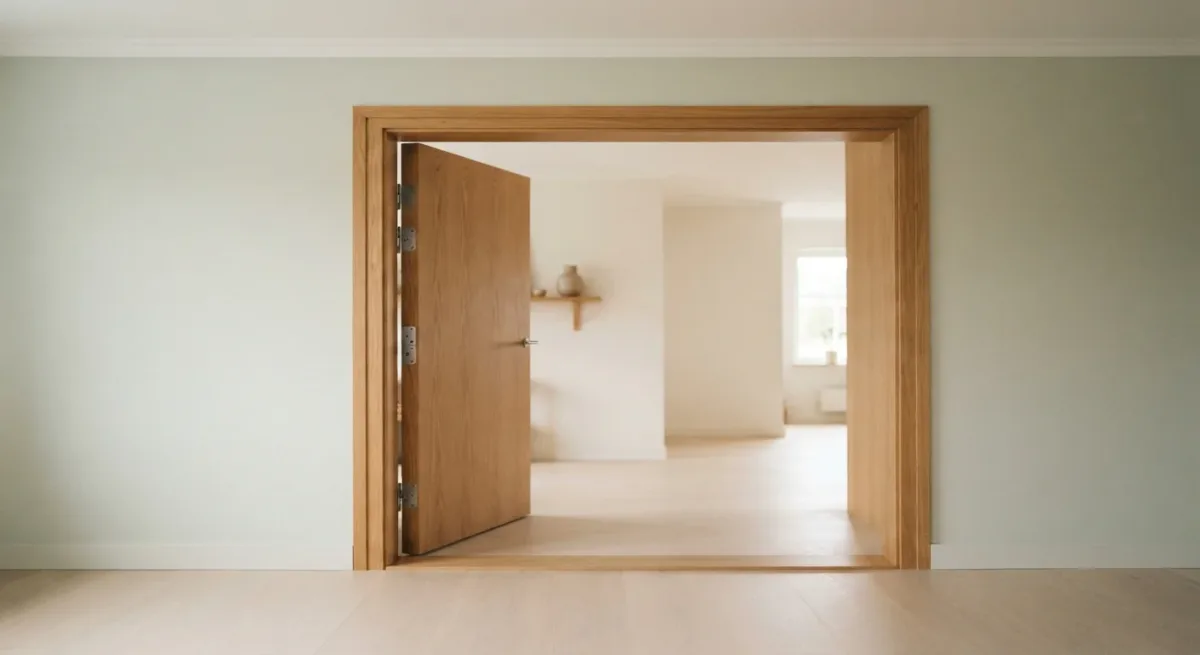
A wheelchair-accessible doorway needs 32 inches of clear width with the door open at 90 degrees, per the 2010 ADA Standards for Accessible Design — and most standard interior doors give you 28 to 30 inches. There are three ways to close that gap, in rising order of cost: swing-clear hinges at roughly $30-60 per door, removing the door and reframing the opening for several hundred to about $2,000 per doorway (2024 contractor estimates), or, in some homes, reversing which way the door hangs. Requirements for rentals and funded programs vary by jurisdiction, so confirm local rules before work begins.
Spedtacular Daily Living publishes information, not construction, legal, or financial advice — dimensions here come from the named standards, and structural work needs a qualified contractor.
Why 32 inches, exactly?
The 32-inch figure is the clear width, measured from the face of the door at 90 degrees to the stop on the opposite jamb — not the width of the door slab. The ADA's 2010 standards set 32 inches as the minimum for accessible routes, with 36 inches the preferred target in ANSI A117.1 (2009 and later editions), the standard most local building codes reference for residential work. A "30-inch" door usually delivers about 28 inches of clear width once you subtract the slab thickness and the stops; that four-inch shortfall is the entire project.
Which fix fits your door?
Measure first: open the door to 90 degrees and measure from its face to the far jamb stop. Then match the number to the option.
| Option | Clear width gained | Typical cost (2024) | Best for |
|---|---|---|---|
| Swing-clear (offset) hinges | about 2 inches | $30-60 in hardware, DIY-friendly | Doors within 2 inches of the target |
| Remove door entirely | full opening | near $0, plus a curtain or privacy solution | Closets, spaces where privacy needs are low |
| Reframe and install a wider door | as needed | $700-2,000 per doorway, contractor bids | Load-bearing or high-traffic doorways |
Swing-clear hinges move the door out of the opening when it swings, which is why they buy back almost exactly the slab's thickness. They fit standard hinge cutouts in most cases, per manufacturer installation documents — but only if the wall and jamb are plumb, which older homes often lack.
How is a reframe actually done?
For the full widening, the documented process a licensed contractor follows is:
- Verify what's in the wall — electrical runs, plumbing, and whether the wall is load-bearing. Load-bearing means an engineer-sized header, and the permit that comes with it.
- Cut back the drywall on both sides to the new rough opening, typically for a 34- or 36-inch door slab.
- Install the new header and king studs; this is the step that cannot be improvised on a structural wall.
- Set the new prehung door, plumb and shim it, and reinstall casings.
- Relocate the light switch if it now falls outside reach range — reachable controls belong within 15-48 inches of the floor, per the ADA's reachable-controls provision.
Permits: most jurisdictions require one for structural framing changes, and widening almost always counts. Contractors pull them; ask for the permit number on the bid.
What if you rent?
Renters have a documented path: the Fair Housing Act requires landlords to allow reasonable modifications to existing premises, at the tenant's expense in most cases, for a disability — that's 42 U.S.C. § 3604(f)(3)(ii), and HUD's 2020 guidance on assistance animals and its modification guidance describe the mechanics. Landlords may require the work be done reasonably and, in some cases, that you restore the premises at move-out — though where a modification doesn't interfere with the next tenant's use, restoration demands are limited. Funding programs, described below, sometimes pay.
Who might help pay for it?
Three named programs, eligibility stated as each program states it:
- Medicaid Home and Community-Based Services (HCBS) waivers — many state waivers cover environmental accessibility modifications; covered work and dollar caps vary by state, per each state's waiver plan.
- VA Home Improvement and Structural Alterations (HISA) grant — up to $6,800 for service-connected conditions, $2,000 otherwise, per the VA's published program terms (2024).
- Local Area Agency on Aging and Center for Independent Living programs — home-modification funds vary by county and often have waitlists; availability is genuinely local.
None of these is an entitlement you can count on by listing it here — each application is decided on its own program rules.
What the sources leave open
Cost figures are 2024 estimates and vary widely by region and wall type; no national dataset of doorway-widening costs exists. And no supplied source establishes how often swing-clear hinges satisfy the full 32 inches in practice — that depends on the individual door, which is why the first step is your own tape measure.