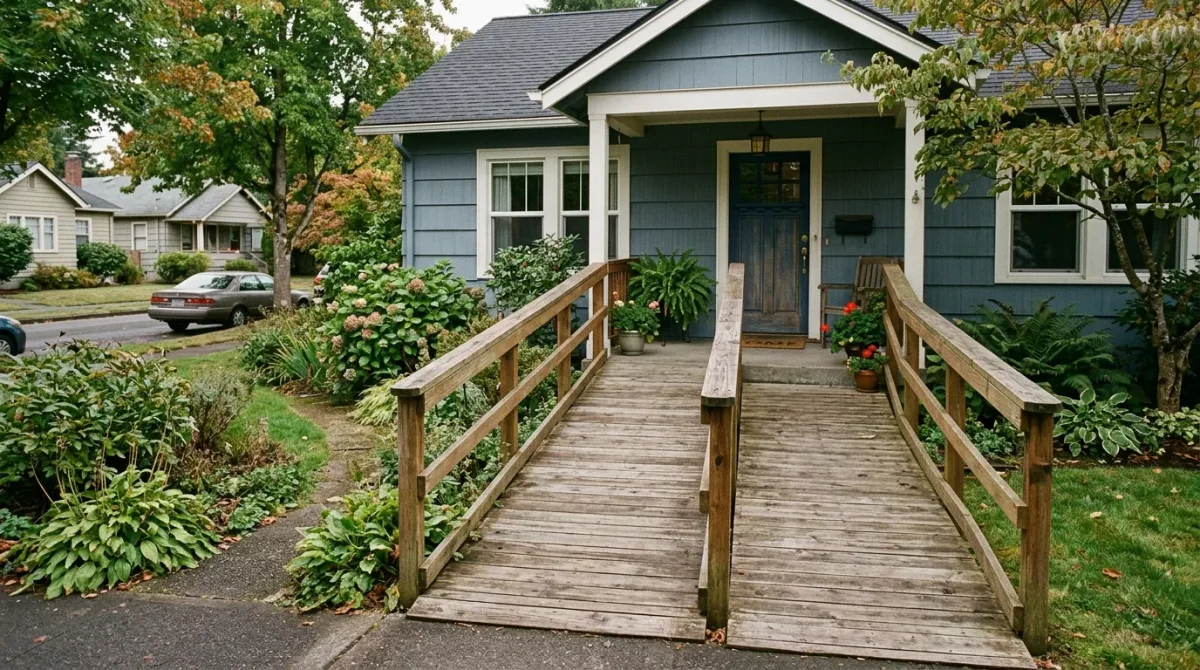
A compliant wheelchair ramp needs a running slope no steeper than 1:12 and at least 36 inches of clear width, per the U.S. Access Board's ADA Standards for Accessible Design; the U.S. Department of Veterans Affairs pays up to $6,800 toward building one through its HISA grant, and Medicaid HCBS waivers cover ramps in many states but under rules that vary state by state. This article explains how the programs work and what they pay — it is not financial, legal, or medical advice, and eligibility for any program is determined by that program, not by this article.
What makes a wheelchair ramp meet the ADA standard?
A ramp meets the ADA Standards for Accessible Design when its running slope is 1:12 or flatter (one inch of rise for every 12 inches of ramp length) and its cross slope does not exceed 1:48, according to the U.S. Access Board's guide to Chapter 4 of the standards. That 1:12 ratio is the maximum allowed slope, not a target — a flatter ramp is easier to use.
The standard sets several other minimums. Clear width must be at least 36 inches, measured between handrails where they're installed. No single ramp run can rise more than 30 inches before it needs a landing, and landings at the top, bottom, or wherever the ramp changes direction must be level and at least 60 inches by 60 inches. Handrails are required on both sides whenever a ramp's total rise exceeds 6 inches, set 34 to 38 inches above the ramp surface, with 12-inch horizontal extensions at the top and bottom of each run.
These are the ADA's public-accommodation standards; a private home is not legally required to meet them unless it's built or altered with certain public funding, but builders, VA contractors, and Medicaid-approved modification providers commonly use the same dimensions as the baseline for a safe, usable home ramp. Requirements can differ for a private residence versus a place of public accommodation, so check with the program or contractor funding the work about which specification applies.
What does the VA's HISA grant pay for a ramp?
The Department of Veterans Affairs' Home Improvements and Structural Alterations (HISA) grant is a lifetime benefit that pays for medically necessary changes to a veteran's primary residence, including permanent ramps, entrance and exit modifications, roll-in showers, and plumbing or electrical work needed to install medical equipment, according to the VA's Prosthetic and Sensory Aids Service. It does not cover portable ramps, exterior walkways, decking, spas, new construction, or routine maintenance.
The maximum benefit is $6,800 for veterans with a service-connected disability, for veterans whose non-service-connected condition is treated as service-connected through VA care, or for veterans with a service-connected rating of 50 percent or higher. Veterans whose disabilities don't fall into those categories can receive up to $2,000. Both are lifetime caps per veteran, not annual allowances.
To apply, a veteran needs a VA physician's prescription describing the project, diagnosis, and medical justification; a completed VA Form 10-0103; an itemized cost estimate; and a color photograph of the area to be modified. Renters need notarized authorization from the property owner. The VA may inspect the site before or after the work. Veterans should contact their local VA Prosthetic and Sensory Aids Service to start the process and confirm their individual eligibility — that determination is the VA's to make, not something this article can predict.
How do Medicaid waivers cover ramps and other home modifications?
Medicaid's Home and Community-Based Services (HCBS) waivers, authorized under Section 1915(c) of the Social Security Act, let states offer services — including, in many states, home modifications — to people who would otherwise need an institutional level of care, according to the Centers for Medicare & Medicaid Services. CMS oversees the waivers federally, but each state designs and administers its own programs, sets its own target populations and enrollment caps, and applies its own income and resource rules. Roughly 257 separate 1915(c) waiver programs currently operate across the states and D.C., so what's covered, and how much, depends entirely on which state and which waiver a person is enrolled in.
Virginia's Commonwealth Coordinated Care (CCC) Plus Waiver is one concrete example of how a state structures this benefit. Its Environmental Modifications (EM) service pays for medically necessary physical changes to a waiver participant's primary home or vehicle — including wheelchair ramps, doorway widening, bathroom modifications, and grab bars — up to a maximum of $5,000 per household starting each July 1, according to the Virginia Department of Medical Assistance Services (DMAS). Unused funds don't carry over to the next year, and the benefit doesn't cover general home improvements or recreational items. A DMAS-approved provider assesses the need, requests authorization, and bills after the work is finished.
Because every state runs its own waiver or waivers, a household in another state should expect different covered services, different dollar caps, and a different application process — sometimes a different name for the benefit entirely. Contacting the state Medicaid agency or an assigned care coordinator is the only way to find out what a specific waiver in a specific state actually pays.
Steps to find out what your state or the VA will pay
- Identify the right program first. Veterans with a VA disability rating start with HISA; Medicaid waiver participants start with their state's HCBS waiver; someone eligible for both should ask each program how it treats modifications already funded elsewhere.
- Get a written, itemized estimate. Both the VA and Virginia's DMAS process require an itemized cost estimate from a provider before authorizing payment.
- Confirm the medical-necessity documentation each program requires. HISA needs a VA physician's prescription; Medicaid waiver services typically need an assessment and authorization from an approved provider or care coordinator.
- Ask about the dollar cap and whether it renews. HISA's $6,800 or $2,000 maximum is a lifetime benefit; Virginia's EM cap resets every July 1 — other states' caps and renewal rules will differ.
- Build to the 1:12 slope standard even where it isn't legally required. A ramp built flatter than the ADA maximum, with the required landings and handrail heights, is easier and safer to use long-term.
Frequently asked questions
Is the VA's HISA grant a loan that has to be repaid?
No. HISA is a grant, not a loan, and it's a lifetime benefit rather than an annual one. The VA's Prosthetic and Sensory Aids Service caps it at $6,800 or $2,000 depending on a veteran's disability rating and service-connection status.
Does every state's Medicaid waiver cover ramps the same way?
No. States design and run their own 1915(c) HCBS waivers under federal CMS oversight, so covered services, dollar limits, and application steps vary by state and by waiver. Virginia's CCC Plus Waiver, for example, caps its Environmental Modifications benefit at $5,000 per household per year; other states set different limits under different program names.
Does a ramp at a private home legally have to meet the ADA's 1:12 slope standard?
Not automatically. The ADA's ramp dimensions in the U.S. Access Board's standards apply to places of public accommodation; a private residence isn't required to meet them unless certain public funding or program rules apply. Many VA- and Medicaid-funded home ramps are still built to the same 1:12 slope and 36-inch width as a practical safety baseline.
For a related independence perspective, read How Much Clear Space You Need to Move a Wheelchair Through Your Home.