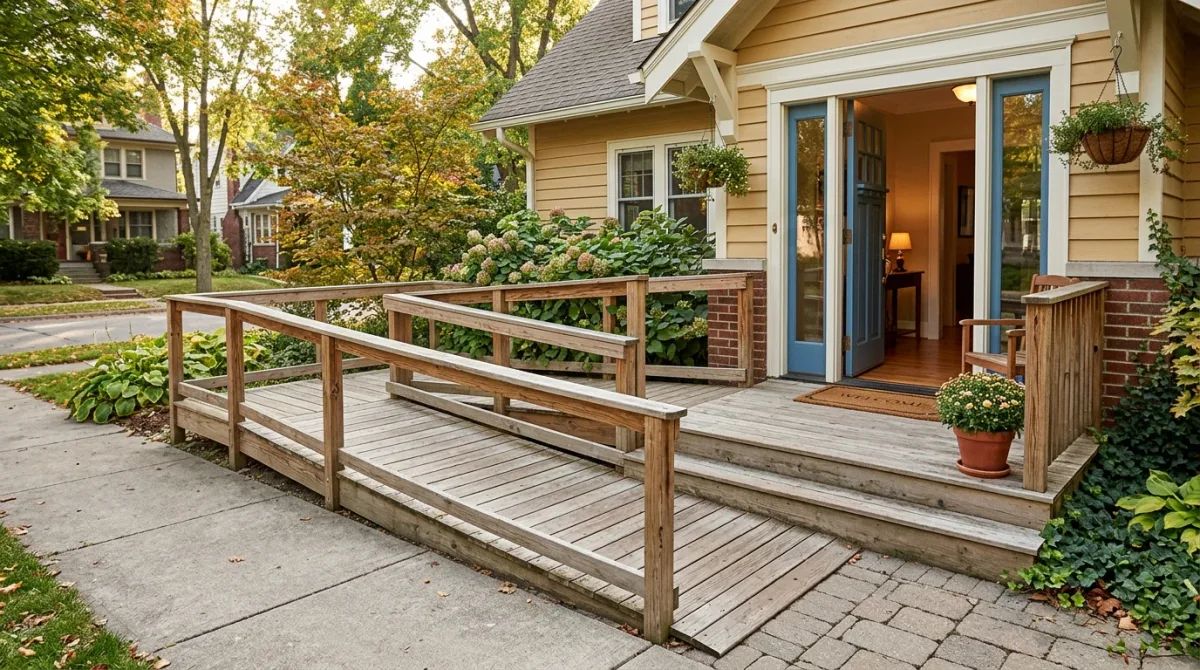
Four different federal programs pay for home modifications, and none of them pay the same way. The VA's Specially Adapted Housing grant runs up to $126,526 in fiscal year 2026; USDA repair grants cap at $10,000 and only for homeowners age 62 or older; Medicaid coverage is set state by state. This is information, not financial or benefits advice.
That spread matters because the money is not interchangeable. One program buys a roll-in shower. Another only removes health and safety hazards. A third may pay for a ramp in one state, not the next.
Which federal programs actually pay for home modifications?
Four, broadly. Two come from the Department of Veterans Affairs, one from the Department of Agriculture, and one from Medicaid through the states. Figures below are as of August 2026, and eligibility decisions belong to the agency running the program.
| Program | Maximum | Who it is for | Variation to expect |
|---|---|---|---|
| VA Specially Adapted Housing (SAH) | Up to $126,526 (FY 2026) | Veterans who own or will own the home, with a qualifying service-connected disability | Federal amount; adjusted by fiscal year |
| VA Special Housing Adaptation (SHA) | Up to $25,350 (FY 2026) | Veterans where they or a family member own the home, with a qualifying condition | Federal amount; adjusted by fiscal year |
| VA Home Improvements and Structural Alterations (HISA) | $6,800 or $2,000 lifetime, depending on category | Veterans and service members; project must be medically justified | Determined locally by Prosthetic and Sensory Aids Service |
| USDA Section 504 repair grants and loans | Grant up to $10,000; loan up to $40,000 | Very-low-income rural homeowners; grants need age 62+ | Income limit set by county |
| Medicaid home and community-based services | Set by each state's program | Medicaid beneficiaries meeting the state's criteria | Services and authorities differ by state |
How much do the VA housing grants pay in 2026?
The VA lists the Specially Adapted Housing grant at up to $126,526 and the Special Housing Adaptation grant at up to $25,350 for fiscal year 2026, according to its disability housing grants page. You can use grant money up to six different times over your lifetime.
The two grants are not tiers of one thing. SAH requires that you own or will own the home, and it is tied to service-connected conditions the VA names — loss or loss of use of more than one limb, certain lower-extremity loss for post-9/11 service, blindness in both eyes at 20/200 or less, and certain severe burns.
SHA is broader on ownership: you or a family member owns or will own the home. Its qualifying conditions include loss or loss of use of both hands, certain severe burns, and certain respiratory or breathing injuries.
There is also a Temporary Residence Adaptation grant for veterans living temporarily in a family member's home. The VA lists it at up to $50,961 for those who qualify for SAH and up to $9,100 for those who qualify for SHA.
What does the VA's HISA grant cover, and what does it exclude?
HISA is the smaller program: a lifetime maximum of $6,800 or $2,000 depending on category, per the VA's Prosthetic and Sensory Aids Service. Every HISA project must be medically justified for the disability in question, and it runs through your VA medical center, not the housing office.
The $6,800 lifetime maximum applies to service-connected disabilities, to compensable disabilities treated as if service-connected, and to non-service-connected disabilities where you hold a service-connected disability rated at least 50 percent. Everything else falls under the $2,000 maximum.
What HISA pays for is concrete: entrance and exit access to the primary residence, essential bathroom facilities such as roll-in showers, accessible kitchen or bathroom sinks and counters, permanent ramping to entrance paths or driveways, and plumbing or electrical work needed for medical equipment.
The exclusions are just as concrete, and they catch people out. Exterior decking is out. Spa, hot tub, and Jacuzzi-type tubs are out. So is removable equipment — a portable ramp does not qualify, a permanent one does. New construction, walkways to exterior buildings, and routine maintenance are also excluded.
The paperwork is specific: a VA physician's prescription with medical justification, a completed VA Form 10-0103, owner authorization if you rent, itemized cost estimates, and photographs of the area before work starts. The VA may inspect the site.
How does USDA money work for rural homeowners?
USDA's Section 504 program splits into a loan and a grant. The loan goes up to $40,000 at a fixed 1% interest rate, termed for 20 years. The grant goes up to $10,000 — $15,000 in presidentially declared disaster areas — and carries an age requirement the loan does not.
To take the grant, you must be age 62 or older, be the homeowner, occupy the house, and have income that does not exceed the very-low-income limit for your county. Because that limit is set county by county, two households with identical income can get opposite answers.
The purposes differ too. Loan funds may be used to repair, improve, or modernize a home or remove health and safety hazards. Grant funds are narrower: they must be used to remove health and safety hazards. Ask your USDA Rural Development office how they read that for the modification you have in mind.
Two more numbers. Loan and grant together cap at $50,000, or $55,000 in disaster areas. Grants must be repaid if you sell the property in less than three years. Full terms are on the USDA program page.
How do Medicaid home and community-based services fit in?
Medicaid pays for home and community-based services through several authorities, and what any one state covers is a choice that state made. HCBS exist so beneficiaries can receive care in their own homes or communities rather than in institutions or other isolated settings, according to the Centers for Medicare & Medicaid Services.
The oldest route is the 1915(c) waiver. CMS states that HCBS first became available in 1983, when Congress added section 1915(c) to the Social Security Act, giving states the option to receive a waiver of Medicaid rules governing institutional care. Forty-seven states and the District of Columbia now operate at least one 1915(c) waiver.
Two other doors exist. HCBS became a formal Medicaid state plan option in 2005 under section 1915(i), and several states include those services in their state plans. Section 1915(k), Community First Choice, is a further option for state Medicaid agencies. The CMS HCBS authorities page shows how they are organized.
The practical upshot: whether environmental modifications — ramps, widened doorways, bathroom changes — are covered where you live depends on your state's program, and so does the waiting list. Ask your state Medicaid agency for the waiver name and its service list rather than relying on any general description, including this one.
How do you work through these in order?
Sequence matters more than speed, because some programs will not reimburse work already done.
- Write down the modification in physical terms — what gets moved, widened, or installed. Programs approve specific work, not goals.
- If you are a veteran or service member, ask your VA medical center about HISA and the VA housing office about SAH, SHA, and TRA — separate applications, separate offices.
- If your home is rural, check your county's very-low-income limit with USDA Rural Development before assuming you are over it.
- Ask your state Medicaid agency, by name, which waiver or state plan authority covers environmental modifications and what the wait looks like.
- Get itemized written estimates. Lump-sum estimates tend to come back.
- Do not start work until you have written approval. Photographs of the unimproved area are part of the HISA file.
None of these programs decides eligibility from a webpage. That is a conversation with the agency. What the published figures give you is a realistic ceiling before you plan around a number.
For a related accessibility perspective, read How to Pay for Home Accessibility Modifications: Grants, Loans, and What They Cover.