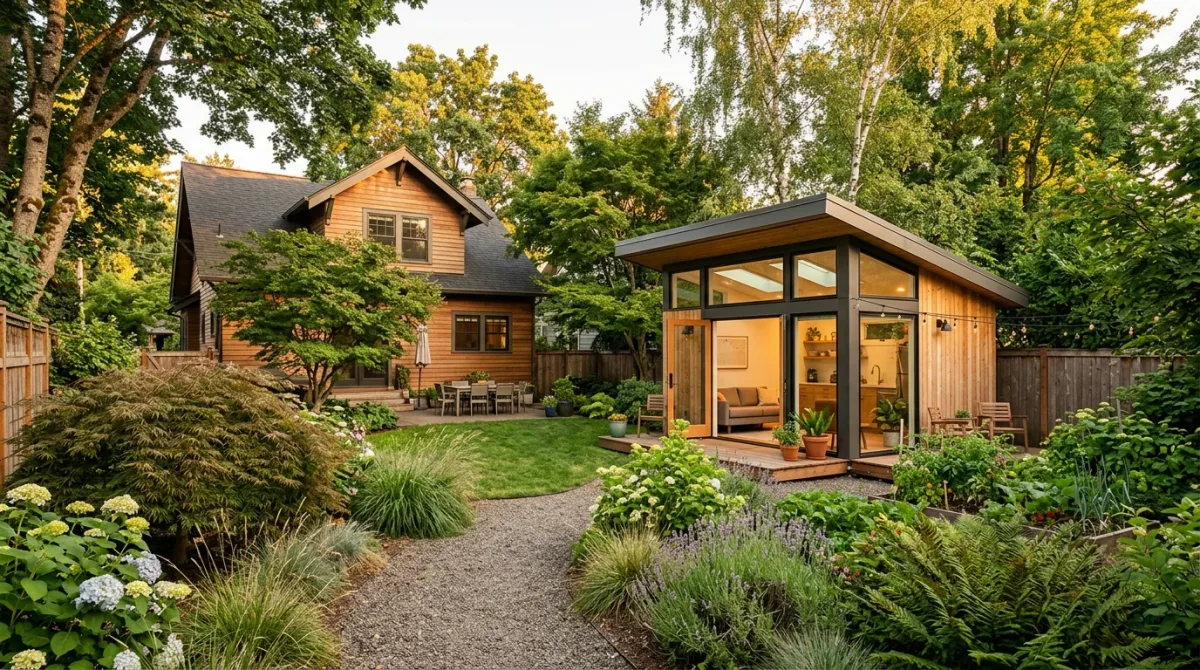
An accessory dwelling unit, or ADU, is a secondary, independently livable home built on the same lot as a single-family house — attached to it, tucked into a garage, or standing alone in the backyard. It has its own kitchen, bathroom, and entrance, and it must be permitted; an unpermitted "in-law suite" someone built without inspection doesn't count, no matter how nice the tile work is. As of 2020, Freddie Mac had identified 1.4 million single-family properties nationwide with an ADU on them, and the pace has only picked up since (SRC-02).
What exactly counts as an ADU?
The core test is independence: a real kitchen, a real bathroom, and a door of its own, on a lot that already has (or will have) a primary house. Seattle's building department defines an ADU simply as "a separate living space within a house or on the same property as an existing or proposed house," and it splits the category into two types — an attached ADU (AADU) carved out of the existing home, and a detached ADU (DADU) built as its own small structure, often where a garage used to sit (SRC-01). A unit can't be sold off as its own lot; it stays legally tied to the main house, which is part of what makes ADUs a housing-supply tool rather than a subdivision loophole. Most jurisdictions that allow them cap the count at one or two per property.
Granny flat, casita, DADU — is that the same thing?
Yes. "Granny flat," "in-law unit," "backyard cottage," "casita," and "secondary unit" are all regional nicknames for the same legal concept; California's Department of Housing and Community Development uses that exact list when describing what an ADU is (SRC-03). The formal term matters mainly for permitting paperwork — a city's code will use "ADU" or the local statutory name, and that's the label an inspector and a lender will look for, not whatever a listing agent calls it in the marketing copy.
Do you need a permit, and what does the process look like?
Yes, always — an ADU is new construction or a change of use, and it has to clear the same structural, electrical, mechanical, and land-use codes as any other residential project. Seattle's permitting office lays out the basic fork: building a new ADU requires a construction addition or alteration permit, while legalizing a unit that already exists (say, a garage apartment someone built without approval) requires a permit to establish use before it can be treated as legal housing (SRC-01). The process, in rough order:
- Confirm the property is zoned for an ADU and check any lot-size, height, or setback limits with the local planning or buildings department.
- Choose attached, detached, or a conversion of existing space (garage, basement) — each has different structural and code implications.
- Submit construction drawings for the addition/alteration permit, or the establish-use permit if the unit already exists.
- Complete separate trade permits as needed — Seattle notes electrical work may require its own utility service application.
- Pass inspections before the unit can be occupied or listed as legal square footage.
Some cities waive requirements that apply to the main house — Seattle, for instance, exempts ADUs from parking minimums, street-improvement obligations, and its mandatory housing-affordability payment (SRC-01). Rules like that vary block by block, which is why the permit conversation has to happen locally, not from a national blog post.
Where is this actually happening, and is it new?
It's growing, but it's not new — homeowners have been converting garages and basements for generations; what's changed is that more of it is now legal and counted. Freddie Mac's research, based on roughly 600 million MLS transaction records going back to the late 1990s, found ADU sales grew from about 8,000 properties in 2000 (1.1 percent of sales) to about 70,000 in 2019 (4.2 percent of sales), an average year-over-year growth rate of 8.6 percent over that decade (SRC-02). California, Florida, Texas, and Georgia together accounted for roughly half of all identified ADUs, with Portland, Dallas, Seattle, Los Angeles, and Miami among the metros posting double-digit growth since 2015 (SRC-02). Freddie Mac's own caveat matters here: the count captures only permitted, MLS-visible units — the unpermitted "shadow" ADUs built without inspection aren't in the data at all, so the real number of backyard units in America is almost certainly higher than any official count (SRC-02).
Has the legal landscape shifted recently?
Yes — state-level ADU law keeps getting rewritten, which is worth knowing even if you're not in the state that changed it, because other legislatures tend to copy what works. In California, Senate Bill 477 renumbered the state's governing ADU and junior-ADU statutes as of March 25, 2024, and the state's housing department maintains an ADU Handbook, updated as recently as March 2026, plus a portal for technical assistance (SRC-03). Local ordinances remain optional on top of state law and have "grown exponentially in number" as more cities opt in, according to the department (SRC-03). The practical takeaway: check the current version of your local code before planning around anything you read here or elsewhere — ADU rules are a moving target almost everywhere they exist.
FAQ
Can I rent out an ADU I build? In most jurisdictions that allow ADUs, yes — that's the point; Freddie Mac's data shows a growing share of ADUs listed and leased as rentals through the 2000s and 2010s (SRC-02), though local rules on short-term versus long-term rental can differ from the rules on the main house.
Is a junior ADU (JADU) the same as a regular ADU? No — California treats JADUs as a distinct, smaller category with its own rules, carved out of an existing home's floor area, separate from standard ADU regulations (SRC-03). The distinctions are set at the state and local level, not nationally.
Does building an ADU mean I can subdivide and sell it separately? No, generally not. Seattle's code, like most ADU ordinances, explicitly prohibits subdividing an ADU from the main house — it stays one legal property (SRC-01).
Do all cities allow ADUs? No. ADU legality is set locally and by state law; some states mandate that cities allow them under certain conditions, while other jurisdictions still restrict or ban them outright, so the first real step is always confirming local zoning (SRC-01, SRC-03).
For a related property news perspective, read Ben Affleck and Matt Damon Make a Splash on Gossip Stone TV.
For more context, read How to Widen a Doorway for Wheelchair Access.
For more context, read film.