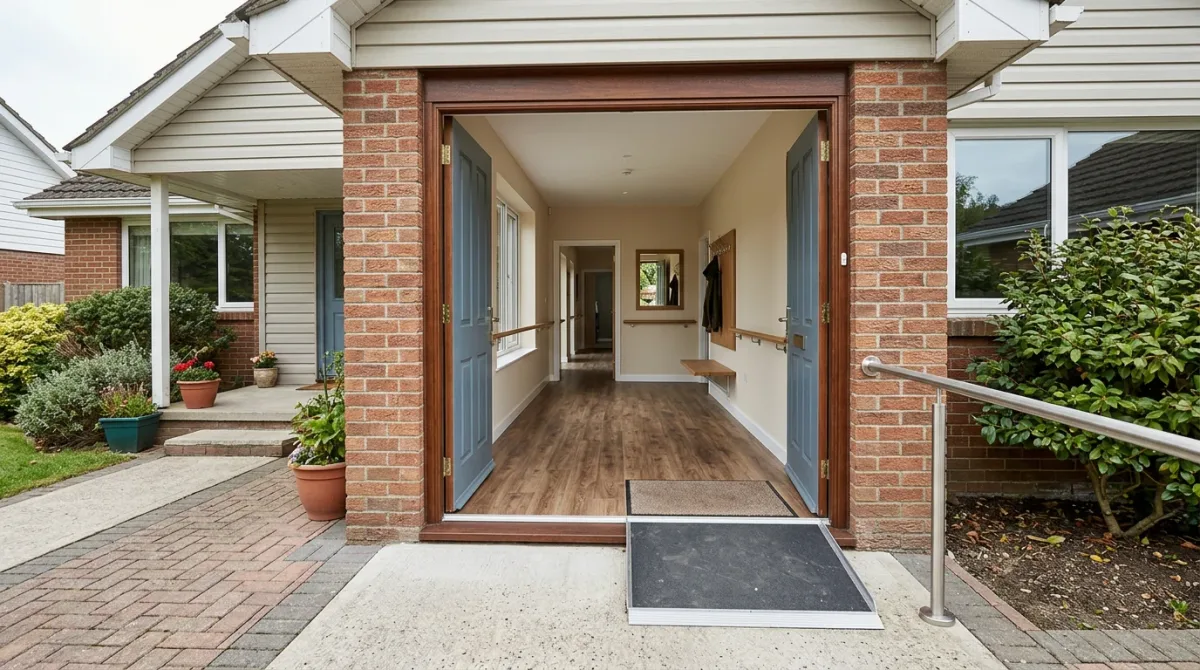
The Americans with Disabilities Act does not set doorway widths, bathroom clearances, or ramp slopes for a private home. It governs public and commercial buildings, per the Department of Justice's ADA Standards for Accessible Design. Whether any accessibility standard applies to your house — and which one — depends on the building type, who financed it, and whether it's a rental.
Does the ADA apply to a private house?
No, in almost every case. The 2010 ADA Standards, issued by the Department of Justice's Civil Rights Division, set minimum accessibility requirements for facilities covered under Title II (state and local government buildings) and Title III (places of public accommodation and commercial facilities). The standards explicitly exclude private residences from most requirements: even when a commercial business operates out of part of a house, only the commercial portion has to comply — the living space doesn't. If you're modifying a single-family home you own and live in, the ADA's dimensions are a useful reference point, not a legal requirement.
What rules actually apply to a private home?
Two other frameworks do the work the ADA doesn't, and they apply in different situations. The Fair Housing Act's design requirements apply to certain multifamily housing built for first occupancy after March 13, 1991 — covered units in buildings with four or more units. The Act's design manual, published by the Department of Housing and Urban Development, sets the accessibility features those units must have, including usable doors and an accessible route through the unit. Separately, ANSI A117.1, a technical standard for buildings and facilities, gets referenced and adopted piecemeal by state and local building codes, and by HUD's own Fair Housing Act guidance as a way to demonstrate compliance. Which one governs a specific project depends on the building's unit count, construction date, and whether public financing or a state building code pulls in additional requirements — a fact pattern worth confirming with your local building department before you assume any single standard covers your project.
How wide does a doorway actually need to be?
The number depends on which standard applies, and the differences are small but real:
| Standard | What it covers | Doorway clear width |
|---|---|---|
| ADA Standards (2010) | Public and commercial facilities | 32 inches minimum clear width, with 36 inches on the continuous accessible route (can narrow to 32 inches at a doorway for up to 24 inches) |
| Fair Housing Act design requirements — accessible doors | Primary entrance of covered multifamily units | 32 inches minimum clear width |
| Fair Housing Act design requirements — usable doors | Interior and secondary doors of covered units | 32 inches nominal clear width (a standard 34-inch door hung normally typically qualifies) |
On the accessible route more broadly, the Access Board's guide to accessible routes puts the general clear width at 36 inches continuous, narrowing to 32 inches only at specific points such as doorways and only for a maximum distance of 24 inches — a distinction that matters if you're planning a hallway, not just a single door. None of these numbers are optional minimums you can round down from; they're the floor a covered building has to clear.
How do Medicaid waivers pay for home modifications?
Separately from which design standard applies, some Medicaid programs help pay for the work. Section 1915(c) home and community-based services waivers and Section 1915(i) HCBS state plan benefits can include "environmental modifications" — physical adaptations to a home that a state's waiver program has approved — among the services a participant may receive, according to federal guidance from the Centers for Medicare & Medicaid Services. Exactly which modifications qualify, and who's eligible, is set state by state in each waiver's own terms; the federal bulletin identifies environmental modifications as an allowable service category without listing the specific adaptations any one state covers. Confirming your state's current waiver language, or talking to your state Medicaid agency or a benefits counselor, is the only way to know what a specific waiver will fund. This publication doesn't determine benefit eligibility for any individual case.
How to figure out which standard applies to your project
- Identify the building type: single-family home, or multifamily housing with four or more units.
- If it's multifamily and was built for first occupancy after March 13, 1991, check whether it's a covered unit under the Fair Housing Act's design requirements.
- Check your local building code — many jurisdictions adopt ANSI A117.1 provisions directly, which can add requirements beyond the federal floor.
- If public accommodation or commercial space is part of the building, confirm whether ADA Title II or III requirements apply to that portion specifically.
- If you're seeking Medicaid help paying for the work, contact your state Medicaid agency to confirm what your specific waiver covers before you commit to a contractor or a design.
None of this is legal advice — it's a map of which federal framework tends to apply where, sourced to each framework's own text. A local building official, fair housing attorney, or your state Medicaid agency can confirm what applies to your specific address and situation.
FAQ
- Does the ADA require my landlord to widen my apartment doorway? Only if the building is a place of public accommodation or falls under Title II; most private apartment buildings are governed instead by the Fair Housing Act's design requirements, per HUD's design manual.
- Is a 34-inch interior door already accessible? Under the Fair Housing Act's usable-door standard, a normally hung 34-inch door typically provides the required 32-inch nominal clear width, according to HUD's Fair Housing Act Design Manual.
- Will Medicaid pay for a ramp or grab bars in my home? Some state HCBS waivers include environmental modifications as a covered service category, per CMS guidance, but coverage and eligibility are set by each state's waiver — confirm with your state Medicaid agency.
- Do I need to follow the ADA when I renovate my own house? No. The 2010 ADA Standards apply to public and commercial facilities, not private residences, per the Department of Justice's design standards.
For a related accessibility news perspective, read Ben Affleck and Matt Damon Make a Splash on Gossip Stone TV.